Buying land for a tiny house: Your 2026 Guide to Ideal Plots

When you decide to buy land for your tiny house, you're really standing at a crossroads. Your two main paths are buying a raw, undeveloped parcel or finding a spot in a dedicated tiny home community. Each route comes with its own set of trade-offs, and the best fit for you depends entirely on your budget, lifestyle, and how much hands-on work you're willing to do.
It’s all about striking a balance between the freedom you crave and the real-world logistics of developing a property.
Starting Your Search for the Perfect Tiny House Plot
The hunt for land is where the tiny house dream starts feeling real. It’s an exciting time, but it’s also where costly mistakes are made. Before you get attached to a beautiful piece of property, you have to do some serious homework to make sure it’s actually a viable place to put a home.
Think of your initial search as a filtering process. You're trying to find a piece of land that hits the sweet spot between what the local laws will allow, what the land itself offers, and what your bank account can handle.
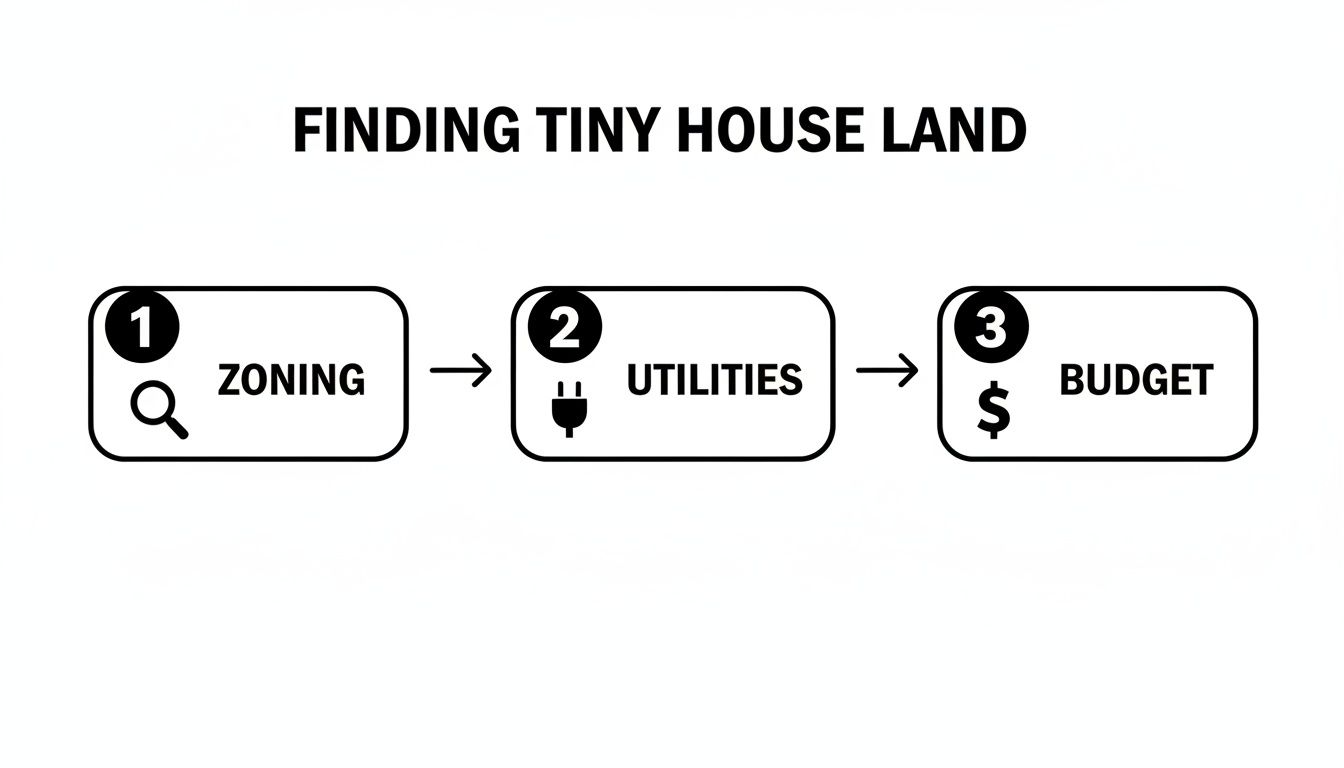
These three pillars—zoning, utilities, and budget—are completely intertwined. If a property fails on just one of these, like having zoning that forbids tiny homes, it’s off the list, no matter how perfect it seems.
Raw Land Versus Community Living
One of the first big decisions you’ll make is whether you want to go it alone on a raw piece of land or settle into an established tiny home community.
Raw land gives you ultimate privacy and creative control. But don’t underestimate the work involved. You're responsible for everything—clearing the land, putting in a driveway, and figuring out all the utilities like a well and septic system.
A tiny home community, on the other hand, does most of that heavy lifting for you. Lots usually come with utility hookups ready to go, and you know the zoning is already sorted out. The trade-off? You’ll have community rules, HOA fees, and much less privacy.
This table offers a quick look at how these two options stack up.
Raw Land vs Tiny Home Community: A Quick Comparison
| Consideration | Raw/Undeveloped Land | Tiny Home Community Plot |
|---|---|---|
| Control & Privacy | Maximum control and privacy. | Limited by community rules (HOA). |
| Upfront Work | High. Site prep, utilities, and access are your responsibility. | Low. Utilities and infrastructure are typically in place. |
| Cost | Potentially lower purchase price but high development costs. | Higher purchase/lease price but predictable utility costs. |
| Zoning & Legal | Complex. You must navigate all local zoning and codes yourself. | Simplified. The community has already secured legal approval. |
| Timeline | Much longer, as site development can take months. | Much faster. You can often move in relatively quickly. |
| Community | Solitary. You're on your own. | Built-in. You're part of an established neighborhood. |
Ultimately, your choice depends on whether you prioritize autonomy and a custom-built environment or convenience and a faster path to tiny living.
Expert Insight: The biggest wildcard in this process is the patchwork of regulations across the country. The tiny house movement is growing fast, but the laws haven't kept up. This makes doing your due diligence absolutely critical before you ever make an offer.
Finding a legal place to park is a real challenge. In fact, our research shows that only 60% of US states have at least one dedicated tiny house community. That leaves the other 40%—a full 20 states—where finding a spot is significantly harder, often forcing you down the raw land path. This is why starting with state-specific research is so important.
Building Your Initial "Go/No-Go" Checklist
Before you start driving out to properties, you need a firm checklist of your non-negotiables. This isn't your dream wishlist; it's a practical filter to quickly disqualify lots that won't work, saving you time and heartache.
Here are the absolute must-ask questions:
- Zoning & Regulations: Is the land zoned for residential use? Are there minimum square footage requirements that would automatically rule out your tiny home? Can you legally live in a Tiny House on Wheels (THOW) long-term, or just a foundation-built home?
- Utility Access: Where is the nearest power pole, and what will it cost to run a line to your build site? Can you connect to city water and sewer, or do you need to budget for a well and septic system (which can easily cost $15,000-$30,000+)?
- Physical & Legal Access: Does the property have direct, year-round access from a public road? If not, is there a legally recorded easement to cross a neighbor’s land? Who maintains that access road, especially after it snows?
Answering these questions first will stop you from falling for a property that’s a legal or logistical dead end. Finding a beautiful, affordable lot that you can't legally access or build on is a classic, painful mistake for first-time land buyers. To get a head start, you can learn more by reading our guide on how to find unrestricted land for tiny homes. Arming yourself with this knowledge will make your search smarter and far more effective.
Getting Friendly with Zoning and Building Codes
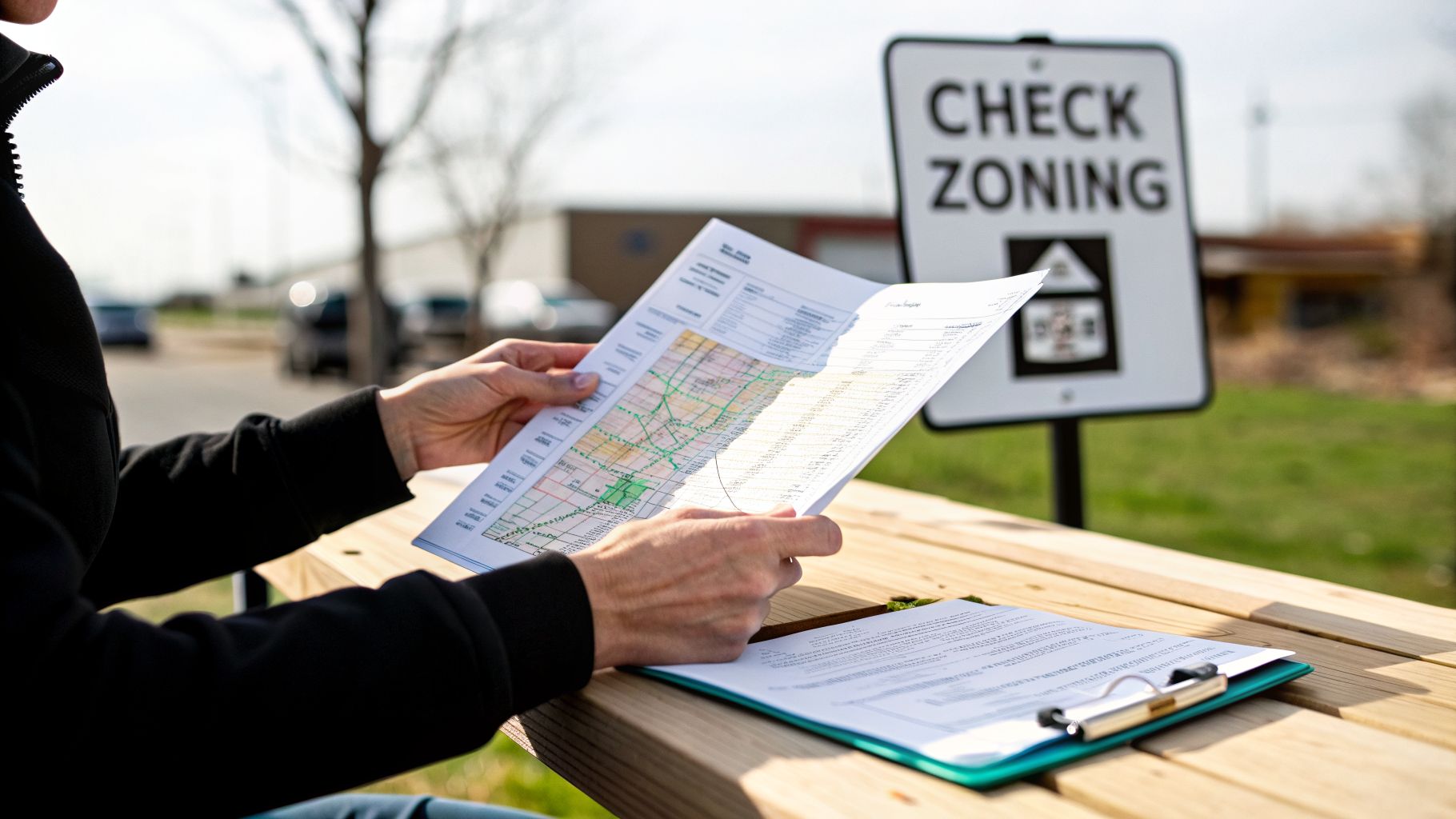
Alright, let's talk about the part where so many tiny house dreams run into a brick wall: red tape. You can find the most beautiful, perfect piece of land, but if the local government says "no," it's a non-starter. This part of the journey is all about legal homework.
Your first, and most important, stop isn't with a real estate agent—it's with the county's Planning and Zoning Department. These are the folks with the final say. Walk in with the property’s address or parcel number and be ready to ask very specific questions. Vague questions get vague answers.
Learning the Language of the Land
When you talk to the planning office, you're going to hear a lot of official jargon. Getting a handle on these terms is the key to getting clear answers and avoiding a very expensive mistake.
Minimum Square Footage Requirements: This is often the first hurdle. Many residential zones have a rule about the minimum size of a house (say, 900 square feet), which can instantly rule out a tiny home. You need to ask, "What is the minimum habitable square footage required for a primary dwelling in this specific zone?"
Accessory Dwelling Unit (ADU): For tiny housers, "ADU" is a magic word. An ADU is a second, smaller home on a property that already has a main house. More and more places are warming up to ADUs, but they usually come with strict rules on size, owner-occupancy, and whether you can even rent it out.
Recreational Vehicle (RV) Classification: This is a big one for anyone with a tiny house on wheels (THOW). Your home will almost certainly be classified as an RV, and most places have strict limits on how long you can live in an RV on a private lot. We’re often talking 30-90 days a year, max. The question to ask is, "What are the county's rules for long-term or full-time occupancy of an RV on private, residentially zoned land?"
Don't just ask, "Can I put a tiny house here?" Be precise about your home and your plans.
Wheels vs. Foundation: What the Law Sees
The legal system sees a world of difference between a tiny house on wheels and one on a permanent foundation. This single detail will dictate your options when buying land for your tiny house.
A Tiny House on Wheels (THOW) is almost always treated as personal property, like a car or an RV. This gives you mobility, but it also means you're subject to vehicle regulations. For full-time living, you’re usually limited to designated RV parks or the rare unincorporated area with lax rules.
On the other hand, a tiny home on a permanent foundation is considered real estate. It’s expected to meet the same state and local building codes as any traditional home. It’s more work upfront with permits and inspections, but it opens the door to being a legally permitted primary home or ADU in a much wider range of locations. For a deeper look at this, our complete guide on zoning laws for tiny houses is a great resource.
A successful land purchase often hinges on this choice. Deciding between a THOW and a foundation home before you start your search will drastically narrow down which properties are even worth considering.
For example, states like California have paved the way by making it much easier to permit ADUs, including tiny houses, in the backyards of existing homes. This has created a whole new world of opportunities for tiny living in more populated areas.
Don't Forget About the HOA
If you’re looking at land in a subdivision or a planned community, you've got another layer of rules to investigate: the Homeowners' Association (HOA). This is a private organization that can enforce rules that are even stricter than the county's zoning laws.
An HOA has the power to regulate things like:
- Minimum house size (often way bigger than a tiny home)
- Approved exterior materials and paint colors
- Parking regulations that might forbid "RVs" or "unenclosed vehicles"
- Landscaping and fencing requirements
Before you even consider making an offer, you must get a copy of the HOA's Covenants, Conditions, and Restrictions (CC&Rs). An HOA can single-handedly kill your tiny house dream, even if the local zoning allows for it. If there's a rule against "temporary structures," your THOW is probably out. If there's a 2,000 square foot minimum building size, your foundation home is a no-go. Don’t take anyone’s word for it; the only thing that matters is what’s written in those documents.
Planning for Utilities and Site Accessibility
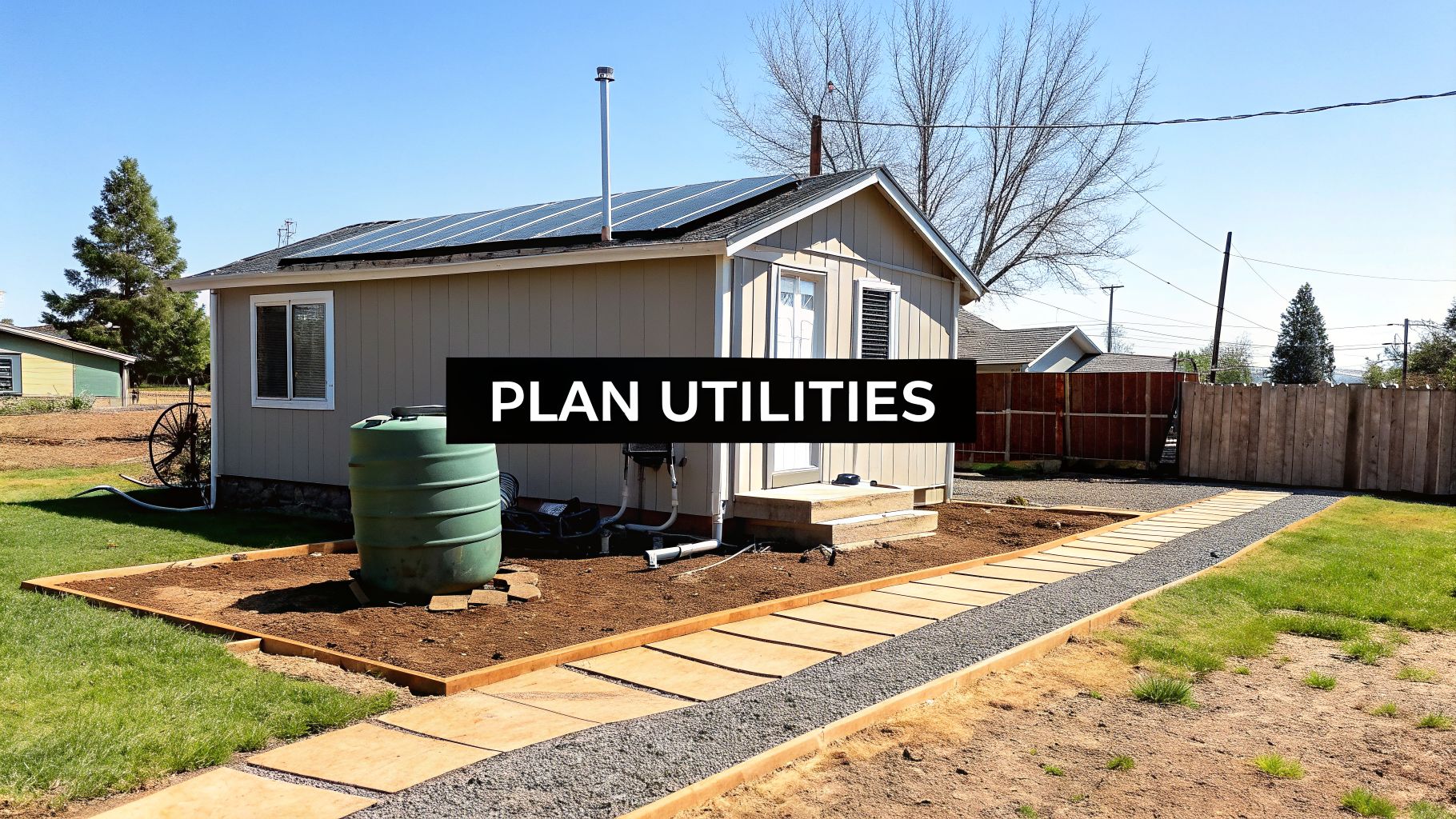
Finding a parcel that allows for a tiny house is a huge win, but that's only half the battle. Now comes the nitty-gritty: figuring out power, water, and waste. These are the unglamorous, often expensive details that turn a beautiful piece of dirt into a livable homesite.
I’ve seen too many tiny house dreams get derailed by unexpected site development costs. What looks like a bargain can quickly become a budget-buster if you haven't planned for these essentials. You generally have three routes to consider: connecting to public utilities, going fully off-grid, or creating a hybrid system.
Connecting to Public Utilities
If your land is within or near city limits, tying into the municipal grid is usually the most direct path. This involves hooking up to public water and sewer lines and getting power from the local electric company.
But "available" doesn't mean affordable. You absolutely must call the local providers to get quotes for connection fees. If the mains are right at your property line, you might get away with a few thousand dollars. But if they're a quarter-mile down the road, the cost to extend those lines to your build site could skyrocket to $20,000, $50,000, or even more.
Pro Tip: Never, ever assume utility access just because you see power lines nearby. During your due diligence period, get formal, written quotes for connection fees and any extension costs. This is the only way to build a realistic budget and avoid a very costly surprise.
Off-Grid Utility Solutions
The allure of self-sufficiency is a major reason people embrace tiny living. This is especially true when you consider that a whopping 72% of tiny house owners live in rural areas where off-grid systems are common. You can dive deeper into these fascinating tiny house statistics and trends to see why this lifestyle is so popular.
Going off-grid means you're in charge of generating your own power, sourcing your water, and managing your waste.
Power: Solar is the king of off-grid power. A complete setup—including panels, batteries, an inverter, and a charge controller—can run anywhere from $10,000 to $30,000+, depending on how much electricity you use. It's also wise to budget for a backup generator.
Water: Drilling a well is the standard for off-grid water. Costs can vary dramatically based on the required depth, but you should budget between $5,000 and $15,000. On top of that, you'll need a pump and pressure tank.
Waste: A septic system acts as your personal sewer treatment plant. A standard system typically costs $8,000 to $20,000, and its approval hinges on a successful "perc test" to ensure the soil can handle wastewater. If your soil fails, you'll need a more complex and expensive engineered system, which can easily double the cost.
Hybrid Utility Models
You don't have to be a purist. A hybrid approach often delivers the perfect blend of reliability and self-sufficiency, giving you the best of both worlds.
For instance, you could connect to grid electricity for reliability but install a rainwater catchment system to water your garden. Or you might drill a well and install septic but stay connected to the public power grid, saving you the big upfront investment of a full solar array. This mix-and-match strategy lets you tailor your setup to your land, your budget, and your lifestyle.
Ensuring Practical and Legal Site Access
So, how do you actually get to your property? It sounds like a simple question, but the answer can be surprisingly complex. A stunning, remote parcel is completely useless if you can't legally and reliably drive to it.
First, you must confirm legal access. If the land doesn't front a public road, you need a deeded easement, which is a formal right to cross a neighbor's land to get to yours. Without a recorded easement, your property is landlocked—a nightmare that makes it nearly impossible to finance, insure, or ever sell.
Next, think about physical access. That charming dirt path might seem fine on a sunny day, but what happens after a week of rain or a heavy snowstorm? Building a proper gravel driveway is a significant expense, often costing $5 to $10 per square foot. For a long driveway, this can easily tack on an extra $10,000+ to your site prep budget.
Finally, if you're sharing an access road with others, insist on a road maintenance agreement. This is a legal contract that clearly defines who pays for and manages upkeep. Without one, a few potholes can quickly escalate into a bitter and costly dispute with your neighbors.
How to Finance and Insure Your Land Purchase
Let's be honest: securing funds for raw land is a different ballgame than getting a traditional mortgage. Most big banks see undeveloped land as a risky bet, especially when you mention you're building something as "unconventional" as a tiny house. But don't let that discourage you. Financing is absolutely possible—it just requires a different strategy.
This is one of the final, and most critical, hurdles you'll face. But successfully navigating the financial side of things is what makes the tiny lifestyle so rewarding. Think about this: 68% of tiny house owners are mortgage-free, a stark contrast to just 29% of average homeowners. Getting this part right can put you on the fast track to real financial freedom. You can dig deeper into these trends on tiny house ownership and see what they mean for your journey.
Your path to financing will almost certainly lead you away from large national banks and toward more specialized, local options.
Common Land Financing Avenues
When a conventional mortgage is off the table, you have to get a little creative. The most successful land buyers I've seen often use a mix of personal resources and niche lending products. Thinking outside the traditional mortgage box is the name of the game.
Here are the most viable routes you should be exploring:
Seller Financing: This can be a golden opportunity. In this scenario, the landowner essentially acts as the bank. You’ll make a down payment directly to them and then pay monthly installments on a negotiated schedule. The terms are often more flexible, since you're dealing directly with a person, not a massive institution.
Local Banks and Credit Unions: Your local credit union is your best friend here. They have boots on the ground, understand the local real estate market, and are often far more flexible with their lending criteria. Walk in prepared with a solid, professional proposal.
Personal Loans: For lower-priced parcels, an unsecured personal loan from a bank or online lender can work well. The interest rates might be a bit higher than a secured loan, but the process is usually faster with less red tape, as the land itself isn't used for collateral.
Home Equity Loans: If you're already a homeowner, tapping into your equity with a Home Equity Line of Credit (HELOC) can give you the cash to buy your land outright. This positions you as a powerful cash buyer, which sellers love.
Key Takeaway: Lenders are all about minimizing risk. The more professional and detailed your plan is, the better your chances. A portfolio showing zoning approval, a site plan with utility cost estimates, and a clear budget makes you look like a safe bet, not just a dreamer.
Securing the Right Insurance Coverage
The moment you own that land, you are responsible for it. Insurance isn't just a good idea; it's a non-negotiable step that protects you from liability and devastating financial loss. You'll need different types of coverage for the land itself and for your tiny house once it's on site.
Getting the right policies from day one is crucial. Imagine someone trespassing on your vacant property and getting injured—without liability insurance, you could be facing a life-altering lawsuit.
Land and Tiny House Insurance Options
For the land itself, you'll need what's called a vacant land liability policy. This is usually an affordable policy that covers you if accidents or injuries happen on your property before your house is built. It’s essential coverage that should be active the day you close.
Insuring the tiny house is a bit more complex, as coverage really depends on how it's classified:
| House Type | Common Classification | Typical Insurance Solution |
|---|---|---|
| THOW (On Wheels) | Recreational Vehicle (RV) | An RV insurance policy is the most common path. If you plan to live in it full-time, make sure the policy includes full-timer liability coverage. |
| On Foundation | Accessory Dwelling Unit (ADU) or Primary Home | This can often be covered under a standard homeowners insurance policy or a specialized dwelling fire policy, especially if it’s built to local codes. |
My best advice is to start conversations with insurance agents early in your land-buying process. Some companies now specialize in tiny home coverage and can offer invaluable guidance. For a more detailed breakdown of your options, check out our complete guide on how to approach tiny home financing. Getting your financial and insurance ducks in a row ensures your new property is a source of peace, not problems.
You’ve navigated the maze of zoning laws and planned out every utility connection. Now comes the final, critical phase: turning that perfect plot of land into your own. This is where you move from dreamer to owner, handling the surveys, negotiations, and closing process that protect your investment and make it official.
Getting this part right is what separates a successful build from a costly mistake. It’s no surprise that 70% of alternative living space owners, including tiny home dwellers, own the land beneath their houses. This provides a foundation for stability and long-term value. You can explore more tiny house statistics on wifitalents.com to see just how impactful land ownership is.
Handling Surveys, Negotiations, and the Closing Process
This is the legal due diligence phase, and frankly, it’s the backbone of a secure purchase. Let’s walk through how to lock down your land the right way.
Why a Professional Land Survey Is Non-Negotiable
Before you even think about making an offer, your first move should be ordering a professional land survey. I’ve seen too many buyers try to save a few bucks by skipping this, and it almost always ends in regret. A survey isn't just about confirming the acreage you're buying; it's an X-ray of your property’s legal and physical boundaries.
Think of it this way: a surveyor acts as your on-the-ground detective. They will physically mark the property corners and create an official map that accomplishes a few crucial things:
- Verifies Boundaries: You get confirmation that the property lines are exactly where the seller claims they are. No guesswork.
- Identifies Encroachments: The survey will immediately flag if a neighbor's fence is creeping onto your land, or if your planned build site is too close to their property line.
- Locates Easements: It uncovers any legal rights of way, like a utility company's access path or a shared driveway, and shows you precisely where they are located.
Don't be tempted to use an old survey from the seller. A lot can change over the years. You need a fresh one conducted specifically for your purchase to ensure everything is current and accurate.
Uncovering the Past with a Title Search
While the survey inspects the physical land, a title search investigates its legal history. A title company will dig through public records to ensure the seller actually has the legal right to sell you the property. This is where you find out if the land has any skeletons in its closet.
The title search is designed to unearth hidden problems, such as:
- Unpaid property taxes
- Outstanding liens from contractors (known as mechanic's liens)
- Existing mortgages or other loans secured by the property
- Ownership disputes from old sales or inheritances
Once the search comes back "clear," your next step is to purchase title insurance. This is a one-time fee that protects you from any future claims or undiscovered issues from the property's past. It’s an absolute must-have when buying land, especially for a tiny house project.
Real-World Scenario: Imagine closing on your perfect plot, only to get a letter a year later from a contractor who was never paid for work done five years ago. Without title insurance, that lien against your property becomes your expensive, stressful problem to solve.
Smart Negotiation and Powerful Contingencies
Armed with your survey and title search, you now have the leverage to negotiate effectively. Land deals aren't like buying a standard house; there's often more room for creative terms, especially when you use contingencies.
A contingency is simply a clause in your offer that lets you back out of the deal—with your deposit in hand—if a specific condition isn't met. For a tiny house land purchase, these are your most powerful tools:
- Zoning and Permitting Contingency: This gives you a window of time, maybe 60-90 days, to get written confirmation from the local authorities that you can legally place and live in your tiny home on the property. If they say no, you can walk away clean.
- Perc Test Contingency: If you're planning on a septic system, this makes the sale dependent on the land passing a percolation (perc) test. A failed test means you can't install a standard septic system, making this contingency absolutely vital.
- Utility Quote Contingency: This protects you from a massive financial surprise. It allows you to exit the deal if the cost to bring utilities (power, water) to your build site exceeds a certain amount. It’s your safeguard against a sudden $50,000 bill just to run power lines.
These contingencies are your safety net. They shift the risk from you to the seller and turn your offer into a safe, calculated decision rather than a blind leap of faith.
The Closing Table and Final Documents
Closing day is the finish line. This is when the property officially becomes yours. You'll meet with the seller (or their representative) and a closing agent to sign the final stack of paperwork and transfer the funds.
The single most important document you'll sign is the deed. This is the legal instrument that transfers ownership from the seller to you. Before you put pen to paper, review it carefully. Make sure your name is spelled correctly and that the legal description of the property perfectly matches what's on your survey.
Once you sign the deed and the money is exchanged, it’s done. The land is yours. Congratulations—you're officially a landowner
Common Questions About Buying Tiny House Land
Once you start seriously looking at land, the "what ifs" and specific questions really begin to pile up. This is where the dream meets reality, and getting clear, honest answers is the only way to move forward without making a costly mistake.
Let's walk through some of the most common questions I hear from aspiring tiny home dwellers. Getting these sorted out will save you a world of headaches later on.
Can I Just Buy Rural Land and Put a Tiny House on It?
This is probably the single biggest myth in the tiny house world, and it's a dangerous one. The fantasy of finding a cheap, unrestricted patch of land and just parking your home is incredibly appealing, but the reality is far more complicated.
Even the most remote-seeming property falls under some kind of jurisdiction, almost always at the county level. And while truly unzoned land is the rare exception, most rural parcels are still bound by rules that can stop a tiny house project in its tracks.
Watch out for things like:
- Minimum Dwelling Size: You'll often find rules stating a primary residence must be at least 800 or 1,000 square feet. This immediately disqualifies most tiny homes.
- Foundation Requirements: Many zoning codes require any permanent home to be on a permanent foundation—a major hurdle for a Tiny House on Wheels (THOW).
- RV Living Restrictions: If your tiny house has wheels, it's legally an RV. Most counties have strict rules that ban living in an RV full-time on private land unless it's in a designated RV park.
The key takeaway is to never assume. Get written confirmation from the local planning and zoning department about their specific rules before you even consider making an offer.
What Is the Real Cost to Get Utilities to Raw Land?
This is where budgets get blown. The cost to develop raw land with utilities can swing wildly from manageable to completely prohibitive, depending entirely on where your property is and what services are nearby.
Here's a realistic look at potential costs:
- Grid Electricity: If there's a power pole right at your property line, getting hooked up might cost $5,000 to $10,000. But if the nearest line is half a mile down the road, you could be looking at a bill for $50,000 or more just for the utility company to extend their service.
- Water Well: For most rural spots, a well is the answer. Plan on spending between $5,000 and $15,000 to have a residential well drilled. This cost can jump significantly if you're in an area where they have to drill very deep to find a reliable water source.
- Septic System: A standard, conventional septic system usually runs from $8,000 to $20,000. The real wild card is the "perc test." If your soil fails, you'll be forced to install a more complex engineered system, which can easily double the cost.
Does a Detailed Tiny House Plan Help Secure a Land Loan?
It certainly helps, but it’s not a magic bullet. Traditional lenders are still very cautious about financing raw land, especially when it’s for what they see as an alternative home.
What a detailed plan does is show you're a serious, well-prepared applicant, not just a dreamer. This instantly reduces their perceived risk.
Your best bet is to assemble a professional proposal package. This should include any letters of approval from the zoning office, a clear site plan showing where the home will go, and formal quotes from contractors for the utility installations. Presenting this to a local credit union or using it to negotiate seller financing gives you much more credibility and a far better shot at success.
What Is the Zoning Difference Between a THOW and a Foundation Home?
This distinction is absolutely crucial. It will define your entire land search and what's ultimately possible on your property. From a legal and zoning perspective, a Tiny House on Wheels (THOW) and a tiny home on a foundation are treated as two completely different structures.
A THOW is legally classified as a Recreational Vehicle (RV). This means it falls under rules meant for vehicles, which almost always prohibit full-time, long-term living outside of a dedicated RV or mobile home park.
On the other hand, a tiny home on a permanent foundation can often be classified as a permanent dwelling. Depending on the jurisdiction, it might be permitted as an Accessory Dwelling Unit (ADU) or even a small primary residence. As long as it meets local building codes, it opens the door to far more residential zones and represents a much more stable, legally sound housing solution.
Explore more tiny home living, design, downsizing, building, and lifestyle resources.