Tiny Homes for Sale Financing

Dreaming of a tiny home but stuck because it won’t qualify for a standard mortgage? You’re not alone. Most banks treat these compact dwellings as RVs or non-traditional builds, so buyers need smarter tiny homes for sale financing options instead.
Common paths include personal loans for quick cash, RV loans if it’s on wheels, builder financing through your home’s maker, home equity from your current property, or straight cash to skip debt altogether. The best choice hinges on one key factor: whether your tiny home sits on wheels or a permanent foundation. Wheels models get vehicle-style loans because lenders see them that way; foundation ones might tap home equity or builder deals, as they act more like real estate.
Expect builds to cost $30,000 to $82,500 on average. Homes on wheels run $30,000 to $70,000, while foundation versions cost more due to setup needs. Add $50,000 to $150,000 for land, utilities, and installation, so totals often hit $100,000 or beyond.
Lenders focus on your credit score (aim for 600 or higher, 720 for top rates), steady income to cover payments, and the home’s official classification. In this post, I will break down each option, compare rates, and show you how to pick the right fit for your dream setup.
Start here: is the tiny home real estate, an RV, or personal property?
Your tiny home’s setup decides everything about tiny homes for sale financing. Banks classify it as real estate, an RV, or personal property based on how it’s built and placed. Real estate means a permanent foundation; it acts like a house. RVs sit on wheels with a VIN number; lenders treat them like vehicles. Personal property includes movable units on skids; these feel more like big trailers.
Most tiny homes count as personal property because of their small size and lack of permanent ties to land. That shifts you away from mortgages toward RV or personal loans, which mimic car financing with shorter terms and higher rates. Foundation models build equity like regular homes, but wheels open RV park options at lower costs upfront.
Before you apply, run this quick checklist. First, confirm your home’s class with the builder or county. Next, gather proof like a VIN or foundation permit. Then, check local zoning for your spot. Finally, tally all costs beyond the build price. These steps avoid loan denials and surprises.
Tiny home on a foundation vs on wheels, why it changes your loan options
Foundation tiny homes look like mini houses. Builders set them on concrete slabs or piers that meet local codes, often under the International Residential Code (IRC). You own land or have long-term rights to it. Lenders spot permanent setups through permits, utility meters for water and electric, and a Certificate of Occupancy. These qualify for mortgage-style loans because banks see real estate value.
Wheeled tiny homes roll on trailers. They stay under 400 square feet to fit RV rules like ANSI A119.5. Expect a chassis with visible tires, hitch, and VIN plate. Lenders check for RVIA seals that prove recreational use. If it passes, you snag RV loans with 10-20% down and terms up to 20 years. However, many lack full certification, so they fall back to personal loans.
In short, foundations unlock home equity paths. Wheels keep things mobile but limit you to vehicle financing. Pick based on your lifestyle; permanence costs more now but pays later.
The certification and paperwork that can make financing easier
Lenders demand clear proof your tiny home meets standards. Start with build specs and a detailed purchase contract from the seller. Wheeled units need a serial or VIN number for tracking. Get an appraisal to set value and an inspection report for safety checks. Proof of insurance covers risks like fire or storms.
Buying from established builders simplifies this. They often provide third-party certifications, such as RVIA seals for wheels or IRC stamps for foundations. These cut red tape because banks trust them. For example, a certified park model avoids extra scrutiny.
Gather everything early. Credit reports and income stubs go alongside. Strong paperwork boosts approval odds and lowers rates.
Don’t forget the “not on the price tag” costs that affect your loan amount
The home price grabs attention, but extras pile up fast. Land purchase runs $20,000 to $100,000 per acre; leases cost $250 to $1,500 monthly. Site prep levels ground with gravel ($2,000 to $10,000) or pours foundations ($5,000 to $20,000).
Delivery hauls your home to site. Permits ensure zoning compliance. Utility hookups add $3,000 to $15,000 for water, sewer, or electric; off-grid septic or wells hit $10,000 plus. Skirting and tie-downs secure wheels models. Insurance and taxes follow based on class. Storage fees apply if you park off-site.
Underestimate these, and your loan falls short. For instance, total extras often reach $20,000 to $50,000. Budget full outlay upfront. Local quotes prevent shocks.
Tiny home financing options in 2026, and who each one fits best
You have real choices for tiny homes for sale financing in 2026. Personal loans offer speed. RV loans cut rates for wheeled models. Builder deals bundle everything. Home equity taps your current property for low costs. Each fits different buyers based on credit, home type, and speed needs.
First, check this snapshot of typical terms. Rates start low with great credit but climb for fair scores. Down payments vary by security. Longer terms ease monthly hits.
| Option | Best For | APR Range | Down Payment | Term Length |
|---|---|---|---|---|
| Personal | Good credit, quick buy | 6.5%–36% | 0% | 2–20 years |
| RV | Mobile homes | 7%–18% | 10%–20% | Up to 20 years |
| Builder | New builds | 8%–18% | 10%–20% | 10–20 years |
| Home Equity/HELOC | Existing homeowners | 6%–12% | 0% | 5–30 years |
This table pulls from lenders like LightStream and SoFi. Shop around because your score changes the math. Now, let’s break down each path.
Personal loans: fast approvals, higher payments
Personal loans work as unsecured cash. Banks like LightStream or SoFi approve them fast because no collateral ties you down. You borrow up to $100,000, perfect for smaller tiny homes around $50,000.
Terms run 2 to 20 years. APR spreads wide, from 6.5% with top credit to 36% otherwise. Excellent scores snag mid-single digits. Fair credit pays more.
Monthly payments hit hard because shorter terms pack principal tight. A $50,000 loan at 10% over five years means about $1,060 monthly. Still, it fits if you need a quick close. No home inspection slows you. Smaller builds stay affordable. You keep assets free for other uses.
Grab this if your credit tops 660 and you hate delays. Prequalify online in minutes. Compare at least three lenders. Zero down seals the deal for cash-strapped buyers.
RV loans: often lower rates if your tiny home qualifies
RV loans target tiny homes on wheels. Lenders like USAA or Southeast Financial see them as vehicles. You get lower rates than personal options, around 7% to 18%. Terms stretch to 20 years. Down payments sit at 10% to 20%.
Your home must pass as an RV. Expect inspections for standards like ANSI A119.5. Builders add RVIA seals to help. No seal? You fall back to personal loans.
Here’s a quick qualify check:
- Yes: Chassis with tires, hitch, VIN number, under 400 square feet.
- No: Permanent foundation, full house utilities, over RV size limits.
- Maybe: Park model with wheels but home features; get pro appraisal.
This path suits mobile lifestyles. Longer terms drop payments to $400 monthly on $50,000. However, you park at RV spots first. Rates beat unsecured if credit hits 660. Apply after certification.
Builder financing: convenient, but compare the full deal
Builders offer in-house or partner loans. They bundle purchase with financing. Custom builds use draw schedules; funds release as work hits milestones.
Expect 8% to 18% APR, similar to RV loans. Terms last 10 to 20 years. Down payments run 10% to 20%, sometimes more as deposits. Credit needs 620 plus.
Watch hidden costs, though. Origination fees add 1% to 2%. Builders bake higher prices into deals. Prepayment penalties lock you in. You might pay extra for their lender tie-up.
Always compare. Pull quotes from two outside sources. Check full APR and total payback. If builder beats them, go ahead. Convenience shines for first-timers. It speeds delivery because paperwork flows together.
This fits buyers locked into one maker. However, shop smart to avoid overpaying.
Home equity loan or HELOC: cheaper money, bigger risk
Homeowners tap equity from their main house. Rates dip to 6% to 12%, lowest here. No new down payment because your property secures it. Terms go 5 to 30 years.
Home equity loans give lump sums with fixed rates. HELOCs let you draw as needed, like a credit card. Both need 20% equity, 620 credit, steady pay.
Risk looms large. Default means foreclosure on your current home.
When smart:
- You own land for the tiny home.
- Steady job covers double payments.
- Long-term plans build equity fast.
When too risky:
- Tight budget leaves no buffer.
- Job feels shaky.
- Tiny home sits far from your main property.
Pick this for stationary builds. It saves thousands in interest. Consult your bank early. Equity grows your net worth if all clicks.
How to qualify and get a better rate without making it complicated
You can lock in the best tiny homes for sale financing without weeks of hassle. Lenders care about your credit score, debt-to-income ratio, stable income, cash on hand, and solid proof of your home and land plans. Aim for a 660+ credit score to open better options; push toward 720 for the lowest rates. Follow this weekend plan to qualify fast and shop smart.
Saturday morning: Pull your free credit report and score. Fix errors right away.
Saturday afternoon: Gather docs and prequalify with three lenders using soft credit checks.
Sunday: Crunch numbers on payments, down payments, and reserves. Pick your top offer, then apply with a hard pull.
This keeps things simple. You avoid dings to your score from multiple hard inquiries. Plus, real data from lenders beats guesses. Let’s break it down.
Pre-quote first, then apply: a simple way to shop rates
Start with prequalification. It uses a soft credit check, so your score stays safe. Lenders give rate estimates based on basic info without a full application.
Compare at least three offers. Rates vary; one bank might hit 7% while another charges 12% for the same profile. This shop saves thousands over the loan life.
Have these ready for quick prequals:
- Recent pay stubs or tax returns to prove steady income.
- Your tiny home details, like builder specs or VIN.
- Housing plan, such as land lease or parking spot proof.
- Builder invoice for the home cost.
- Insurance quotes to show coverage.
Prequal online in minutes at places like LightStream or SoFi. Note the full APR, not just the headline rate. Then apply only to your favorite. Hard pulls come last, and they count as one if done within 14-45 days.
Down payments and cash reserves: how much to save and why it helps
Personal loans often skip down payments altogether. RV and builder options ask for 10% to 20%, around $3,000 to $14,000 on a $50,000 home. Save what fits your path.
Extra cash changes everything. It shrinks your loan size, so payments drop and approval odds rise. Lenders love reserves because they signal you handle surprises.
Think ahead to setup costs like delivery or hookups. A $10,000 buffer covers them without stress. For example, stash three to six months of future payments in savings. This impresses underwriters. You qualify easier and negotiate better terms.
Build reserves now. Cut small expenses or sell extras. Your future self thanks you when rates improve.
Debt, income, and monthly payment: pick a loan you can live with
Lenders check if payments fit your budget. Keep debt-to-income under 36% to shine. That means total debts, including the new loan, stay below 36% of gross income.
Add up real costs for a sanity check. Start with the loan payment. Toss in insurance at $50 to $150 monthly. Factor parking or land lease, $250 to $1,000. Utilities run $100 to $300. Maintenance adds $50 to $100.
Here’s a simple rule: Aim for total housing costs under 28% of take-home pay. For a $4,000 monthly income after taxes, cap it at $1,120. Leave buffer for repairs or moves, say 10% more.
Test scenarios. A $50,000 RV loan at 9% over 15 years pays $507 monthly. Add $400 land and $200 others; total hits $1,107. Fits most budgets. Tweak terms if needed. Stable income seals approval. You got this.
Avoid expensive mistakes: land, zoning, insurance, and resale reality
You lock in tiny homes for sale financing only to face land headaches or zoning blocks. These issues kill deals or add thousands in fixes. Lenders pull back because they spot risks to your payments and exit plan. First, nail your land choice. It shapes loan terms and approval speed. Then tackle zoning early. Insurance and taxes hit your budget hard. Resale stays tough, so banks offer shorter loans or higher rates. Check everything now. You avoid buyer’s remorse later.
Land plan first: buy land, rent a pad, or use a tiny home community
Your spot affects lender trust big time. Banks want proof you park legally long-term. Buy land for ownership appeal. It boosts mortgage odds on foundation homes. Rent a pad keeps costs low but screams temporary to lenders. Communities offer ready spots yet add rules.
Each needs paperwork. Land buys require title deeds and surveys. Rented pads demand lease agreements with 1-5 year terms. Communities share HOA rules on size and hookups.
See how they stack up. This setup influences your down payment and rates.
| Option | Pros | Cons | Lender Impact | Key Paperwork |
|---|---|---|---|---|
| Buy Land | Full control, equity build | High upfront cost ($20k+) | Strong for home loans | Deed, survey, zoning approval |
| Rent Pad | Low entry ($300-800/mo) | No ownership, rent hikes | RV loans only, shorter terms | Signed lease, utility proof |
| Tiny Home Community | Amenities, pre-zoned ($400-1200/mo) | HOA limits, fees | Okay for personal loans | Membership rules, permitted use letter |
Buying land fits long-haulers. Rent or join communities if you test the waters. Lenders favor stability, so attach proof to apps. As a result, you snag better rates.
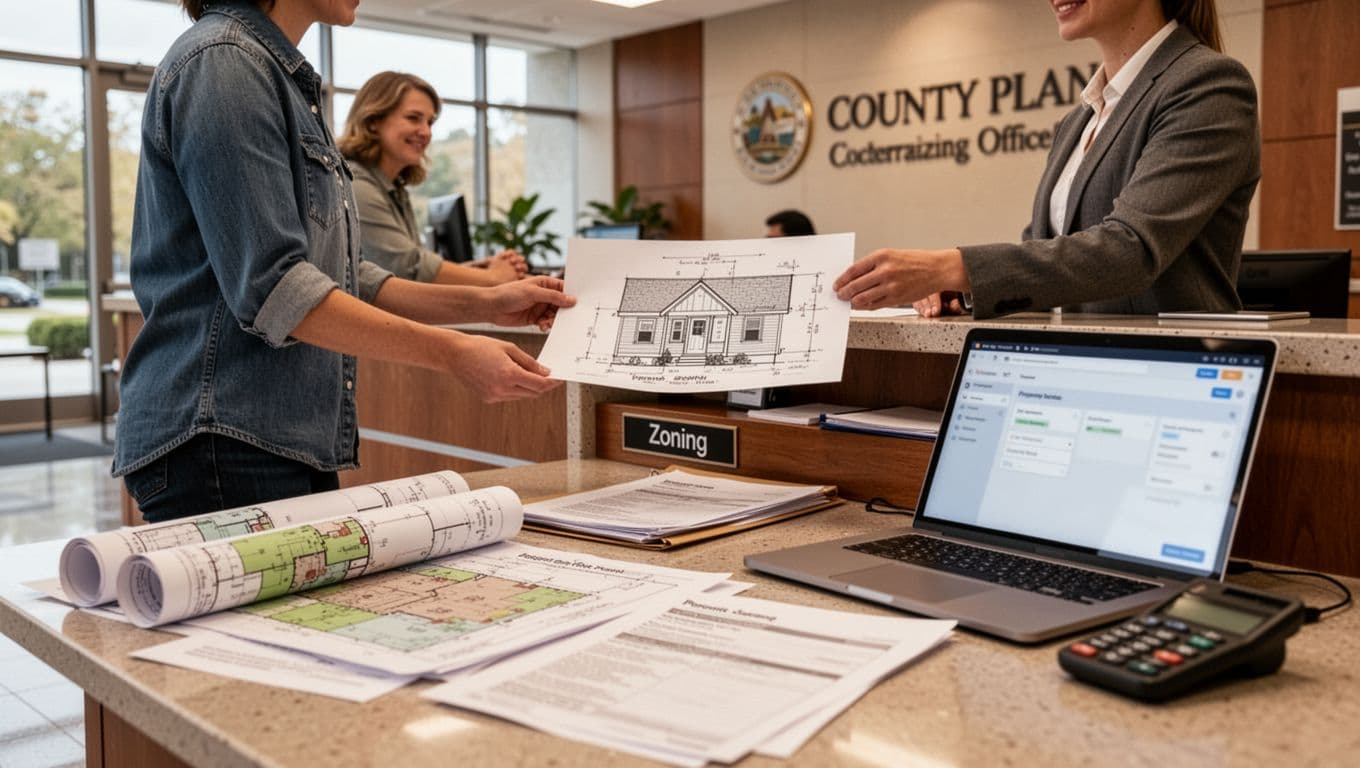
Zoning and permits: the fastest way to get stuck after you buy
Zoning trips buyers most. Rules ban tiny homes in 70% of spots without checks. Common snags include minimum square footage over 400 feet, ADU limits to family only, or RV parking caps at 180 days. Rules vary by county and shift yearly with housing pushes.
Call these spots first. City or county planning office checks land use. Building department eyes permits. Community managers flag HOA bans.
Get it in writing. Email or request letters. You prove to lenders your spot works.
Before you sign, run this check:
- Does zoning allow tiny homes or RVs?
- Any size or foundation rules?
- Permit timeline and costs?
- ADU okay for rentals?
Fixes cost $5,000 plus in appeals. However, pre-checks save your loan.
Insurance and taxes: know the ongoing costs before you choose a loan term
Tiny homes insure as RVs or houses. Wheels models get RV policies at $500-1,500 yearly. They cover travel yet skip full home perks. Foundations need homeowner plans, $800-2,500, for better theft or fire aid. Lenders demand quotes upfront.
Taxes add up too. Foundations pay property tax, 0.5-2% of value, like $500-2,000 yearly. Wheels face personal tax plus DMV tags at $100-500. States differ; Texas hits as improvements.
These run $50-300 monthly. They push debt-to-income over limits. Budget them in loan calcs. Short terms hurt less if costs surprise.
Resale hurts most. Banks see slow sales because buyers fight financing. Wheels depreciate fast. So lenders cap terms at 15 years or hike rates 2-3%. Buy on land for better flips. In short, total ownership runs 20% higher than big homes. Plan now. You sleep better.
Conclusion
You now hold the keys to smart tiny homes for sale financing. First, classify your home as wheels or foundation because that sets your loan path. Next, price the full project; add land, setup, and utilities to the build cost for a true total around $100,000. Then, compare top options like personal loans for speed, RV loans for mobility, builder deals for ease, or home equity for low rates. Finally, pick the lowest-risk choice that fits your budget comfortably.
This approach saves you money and stress. In short, stable income and solid credit open the best doors.
Ready to move? Follow this quick checklist today:
- Check your credit score and fix errors.
- Gather docs like home specs, VIN, or permits.
- Confirm your land plan and zoning.
- Get prequal offers from three lenders.
- Read all fees and full APRs.
Back to Costs and Financing for Tiny Homes
Explore more tiny home living, design, downsizing, building, and lifestyle resources.
- Tiny Homes for Rent in Wyoming: Wild West Getaways to Book
- Tiny Homes for Rent in Washington: Forest Escapes & Cozy Stays
- Tiny Homes for Rent in Utah: Red Rock Retreats to Book
- Tiny Homes for Rent in Oregon: Forest Retreats You’ll Love
- Tiny Homes for Rent in New Mexico: Desert Gems & Starry Skies
- Tiny Homes for Rent in Nevada: Desert Hideaways Worth Booking