Financing a Tiny House on Wheels: Your 2026 Guide to Loan Options

Financing a tiny house on wheels isn’t like buying a traditional home, you can’t just walk into a bank and ask for a standard mortgage.
The path is different, often involving an RV loan for a certified build, a flexible unsecured personal loan, or a chattel mortgage. Your success really boils down to two things: a solid credit score and a meticulously planned budget.
Building Your Financial Foundation for a Tiny Home Loan
Before you start pinning your dream layouts on Pinterest, let’s talk money. Getting your financial house in order is the first, and most critical, step. Lenders need to see you as a safe bet, and that comes from a realistic budget, a strong credit history, and a decent down payment. Honestly, this prep work is non-negotiable. It’s what will make or break your loan options and determine the interest rate you’ll pay.
One of the first things you’ll notice is that tiny house costs are all over the map. You could pull off a DIY build for as little as $30,000, but a high-end, custom home from a top builder can easily sail past $100,000. Your first job is to build a budget that sees beyond that initial sticker price.
Crafting a Comprehensive Tiny House Budget
A classic rookie mistake is to only budget for the house itself. A lender, however, wants to see that you’ve thought through the total project cost. It gives them confidence that you won’t run out of money halfway through, leaving them with an unfinished asset on their hands.
Your budget needs to account for all the extras that can sneak up on you. Be sure to include line items for these often-forgotten expenses:
- Land or Lot Rent: Are you buying land or renting a spot? Monthly lot rents in a tiny home community or RV park can easily run from $400 to over $800.
- Transportation: Getting your tiny house from the builder’s workshop to your chosen spot isn’t free. Depending on the distance, this can cost several thousand dollars.
- Utilities and Hookups: Connecting to water, power, and septic (or installing your own systems) is a significant expense. It’s not uncommon for this to add $5,000 or more to your total.
- Insurance: Lenders will absolutely require proof of insurance. For a THOW, this is a specialized product and can be more costly than you might expect.
- Taxes and Registration: Just like a vehicle, your tiny house needs to be registered. You’ll also owe property or vehicle taxes, depending on your state’s laws.
The Power of Your Credit Score and Down Payment
In the world of tiny home loans, your credit score is king. For most financing, especially RV loans, lenders really want to see a score of 680 or higher. You might find a personal loan with a score in the low 600s, but you’ll pay for it with a much higher interest rate. A score above 720 puts you in the driver’s seat for the best terms.
If your score isn’t quite there yet, spend a few months paying down credit cards and making every single payment on time before you apply. It can make a huge difference.
A strong down payment, typically 10-20% of the total cost, does more than just reduce your loan amount. It signals to lenders that you are financially disciplined and have skin in the game, making you a much more attractive applicant.
Finally, a substantial down payment is essential. Lenders almost always require one, and the bigger, the better. On a $70,000 tiny house, a 20% down payment comes out to $14,000. Having that cash saved shows you’re serious and financially stable.
As you get your finances organized, you can get a clearer picture of what lenders are looking for by reading our guide on how to qualify for tiny home financing. Laying this groundwork now is your ticket to a smooth and successful loan application.
Comparing Your Best Tiny House Financing Options
Financing a tiny house on wheels (THOW) isn’t like buying a traditional home. Forget everything you know about conventional mortgages—they simply don’t apply here because THOWs are classified as personal property, much like an RV or a boat.
This means you’ll be navigating a different world of financing. Your path will depend on your financial health, your credit profile, and whether you’re buying a certified professional build or tackling a DIY project. Let’s break down your most realistic options.
The RV and Chattel Loan Path
For a professionally built tiny house, an RV loan is often the most direct route. But there’s a big catch: your tiny home must be certified by an organization like the Recreational Vehicle Industry Association (RVIA). This certification is a non-negotiable for most lenders, as it assures them the unit meets specific safety and quality standards.
This single requirement is a major roadblock for many. A 2023 survey found that over 70% of tiny homeowners struggled to get this type of financing, pushing them toward personal loans or paying with cash. For those who do qualify, RV loans typically offer terms between 5 to 20 years with interest rates from 6% to 12% (based on 2026 projections) for borrowers with good credit. You can dig deeper into these trends by exploring the full tiny homes market research.
A similar option is a chattel loan. This loan uses the tiny house itself as collateral, just like a car loan. It’s a great alternative if your home is professionally built but lacks that crucial RVIA seal. Lenders may offer up to $100,000, but they view these loans as higher risk, so expect interest rates to be a bit steeper, usually in the 8% to 15% range.
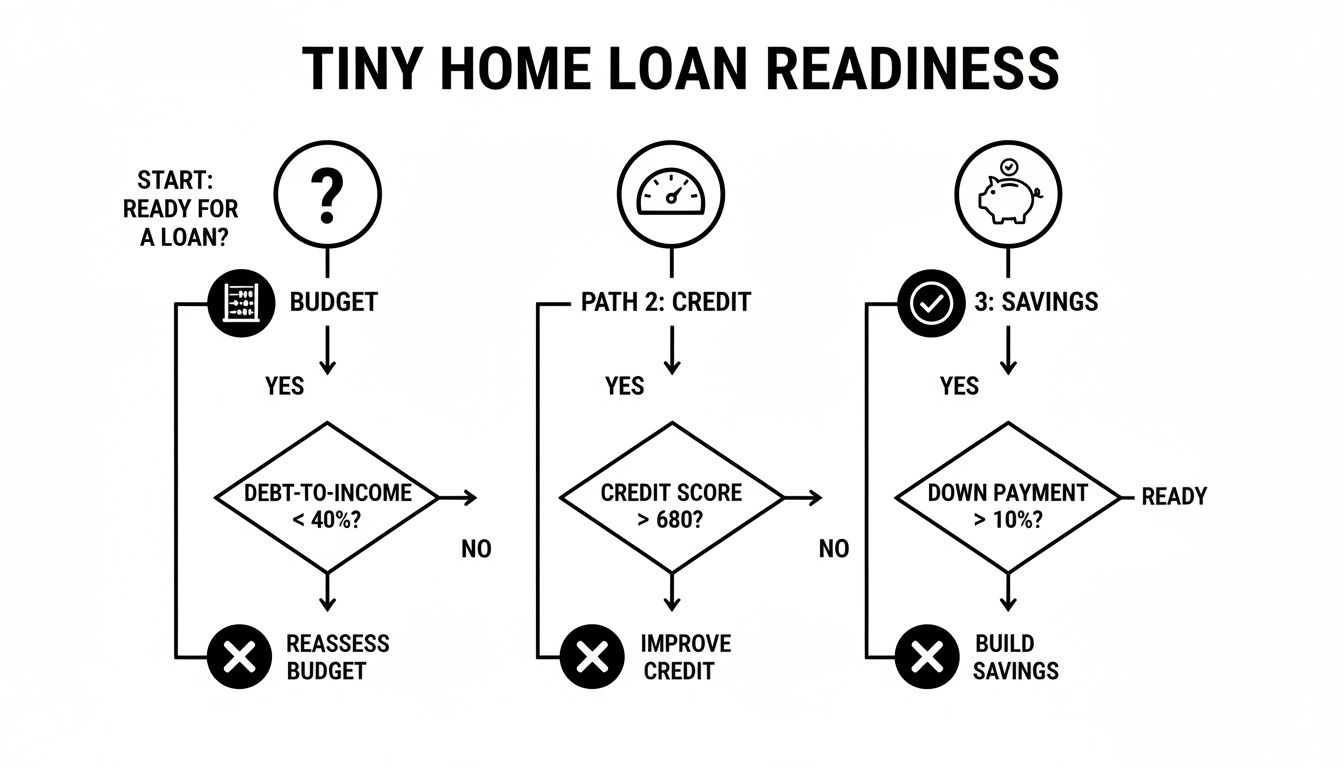
No matter which loan you’re considering, lenders will always come back to the same fundamentals: a solid budget, a strong credit history, and a decent down payment.
To make sense of these choices, here’s a quick comparison of the most common loan types for tiny houses on wheels. This table will help you see how interest rates, terms, and requirements stack up against each other.
Tiny House Loan Options Compared
| Loan Type | Typical Interest Rate (2026) | Loan Term | Best For | Key Consideration |
|---|---|---|---|---|
| RV Loan | 6% – 12% | 5 – 20 years | Professionally built, RVIA-certified THOWs | Certification is almost always mandatory. |
| Chattel Loan | 8% – 15% | 5 – 15 years | Professionally built, non-certified THOWs | Higher interest rates reflect the lender's risk. |
| Unsecured Personal Loan | 7% – 20%+ | 2 – 7 years | DIY projects or buying non-certified homes | Approval is based on your credit, not the house. |
| HELOC | Variable (lower) | 10 – 20 years | Current homeowners with significant equity | Your primary residence is the collateral. |
Each of these loans serves a different purpose and fits a different financial profile. The right one for you depends entirely on your specific circumstances, from the type of tiny house you want to your existing assets.
The Flexibility of an Unsecured Personal Loan
What if your dream tiny house is a DIY build or a custom creation without any official certifications? This is where an unsecured personal loan becomes your best friend.
Unlike RV or chattel loans, a personal loan isn’t secured by the property. The lender isn’t concerned with certifications or build quality. Instead, their decision is based entirely on you—your income, your existing debts, and most importantly, your credit score.
This gives you incredible freedom. You can use the money for a brand-new build, a secondhand unit, or a shell you plan to finish yourself.
Unsecured personal loans almost always carry higher interest rates than secured loans. Lenders take on more risk without collateral, so they charge more to compensate.
Because of the higher risk to the lender, you’ll see interest rates from 7% to over 20%. The loan terms are also much shorter, usually capping out at seven years. This means your monthly payments will be higher than they would be with a 15-year RV loan for the same amount, so you’ll need to budget accordingly.
Using Home Equity for Your Tiny House Dream
If you’re already a homeowner, you might be sitting on your best financing tool: a Home Equity Line of Credit (HELOC). A HELOC lets you borrow against the equity you’ve built in your current home, functioning like a revolving line of credit.
This is an especially powerful option for a DIY build, where you have costs trickling in over time. You can draw funds as you need them for lumber, windows, or appliances, only paying interest on what you use.
The biggest advantages here are the low interest rates and flexibility. Since the loan is secured by your house, the rates are often significantly lower than personal loans and can even beat some RV loans.
But this power comes with serious responsibility. You are putting your primary home up as collateral. If you run into financial trouble and can’t make the payments, the lender could foreclose on your home. It’s a fantastic option, but only for those with a stable financial footing and a rock-solid repayment strategy.
How to Find the Right Lender and Ace Your Application
Knowing which loan is right for you is a huge step, but it’s only half the journey. Now comes the real challenge: finding a lender who actually understands the unique world of tiny homes.
Let me be blunt: walking into a major national bank and saying “I need a loan for a tiny house on wheels” is often a recipe for frustration. Most traditional banks just aren’t set up for it. Their entire system is built around conventional real estate, and a THOW simply doesn’t fit into their neat little boxes.
So, the trick is to stop trying to fit a square peg into a round hole. You need to focus your search on lenders who have already embraced the tiny house movement and created products specifically for financing a tiny house on wheels.

Where to Find Tiny House Friendly Lenders
From my experience, your best bet is to target financial institutions that are more agile and already have a track record with THOWs.
Here’s where I’d start looking:
- Credit Unions: These member-focused institutions are often far more flexible than their corporate banking counterparts. If you have a good history with a local credit union, they might be willing to work with you on an RV or personal loan. It’s all about relationships here.
- Online Lenders: Companies like LightStream or SoFi have become a go-to source for unsecured personal loans. Their application process is typically fast, and they lean heavily on your credit score and income. This can be a great path, especially for DIY builders whose homes won’t be RVIA certified.
- Specialized Tiny House Lenders: This is a growing and exciting niche. A handful of companies now focus only on tiny home financing. They get the nuances of the build process, certifications, and real-world valuations, which can make everything smoother. Many even partner directly with builders.
If you want a head start, our guide on the 30 best tiny home lenders and tips is a fantastic resource for shortlisting potential partners.
Assembling Your Application Package
Once you have a few lenders in mind, it’s time to put together a professional, rock-solid application package. Your goal is to present yourself as a low-risk, organized, and serious borrower. Think of it less as filling out forms and more like pitching a business plan for your new life.
A messy or incomplete application is the fastest way to get a “no.” Taking the time to gather everything upfront shows you respect the lender’s process and are on top of your game.
Lenders are looking for a compelling story. Your application shouldn’t just be a pile of papers; it should be a clear, concise proposal that frames your tiny house project as a sound and responsible investment.
You want to anticipate every question they could possibly have and provide the answer before they even have to ask.
Your Essential Document Checklist
To make your application as strong as possible, get every one of these documents scanned and ready to go. Missing even one item can cause major delays or, worse, an outright denial.
Your Financial Picture:
- Proof of Income: Your last two pay stubs will usually do the trick. If you’re self-employed, you’ll need at least two years of profit and loss statements to show consistent earnings.
- Tax Returns: Lenders will almost always ask for your last two years of federal tax returns. This is non-negotiable for verifying your income history.
- Bank Statements: Have 2-3 months of statements from all checking and savings accounts. This proves you have the cash for a down payment and reserves.
- List of Debts: A simple summary of all current debts—car loans, student loans, credit card balances—so they can calculate your DTI.
Your Project Details:
- Detailed Build Plan (for DIY): If you’re building it yourself, you need to prove you know what you’re doing. This means professional-grade blueprints, a line-item budget for materials, and a realistic construction timeline.
- Purchase Agreement (for Pro Builds): This is the formal contract from your builder. It should outline the total cost, payment schedule, and completion date.
- Builder Information: Lenders will vet your builder. Provide their business history, a portfolio of past work, and any certifications they hold (like from the RVIA).
When you frame your project with this level of detail, you’re not just asking for money—you’re demonstrating competence and dramatically improving your odds of getting that “approved” stamp.
Tackling Insurance, Zoning, and Other Legal Hurdles
Getting a loan pre-approved feels like the finish line, but it’s not. Your lender’s final approval hinges on one thing: protecting their investment. Before they cut that check, they need to be certain your new tiny house is safe from both physical harm and legal trouble. This is where insurance and zoning come in, two of the most common roadblocks I see trip up new tiny home buyers.
From a lender’s point of view, an uninsured tiny home is a terrifying risk. If a fire breaks out or a tree falls on it before the loan is paid off, their money is just gone. That’s why providing proof of a solid insurance policy isn’t just a suggestion—it’s a non-negotiable step to closing the deal.
Finding the Right Insurance for Your THOW
You can’t just tack a tiny house onto your standard auto policy. Tiny houses on wheels (THOWs) live in a bit of a gray area, so you need a specific type of coverage. Lenders will almost always require one of two options.
- RV Insurance: This is your path of least resistance, but it usually requires your home to be certified by the RVIA (Recreational Vehicle Industry Association). These policies are built for a life on the move, covering liability, personal belongings, and damage to the structure itself.
- Mobile/Manufactured Home Insurance: If your tiny home doesn’t have RVIA certification or is intended to be more stationary, this is often the better fit. These policies can offer more comprehensive coverage, sometimes mirroring a traditional homeowner’s policy with better personal liability protection.
To get a quote, you’ll need to have key details ready for the insurer: your builder’s information, the home’s Vehicle Identification Number (VIN), and its appraised value. Don’t be surprised if the premiums are 20-50% higher than typical RV insurance; the custom-built nature of most tiny homes makes them a unique risk.
A Quick Pro Tip: Your lender will absolutely require you to name them as a “loss payee” on your policy. This is standard practice. It simply means that if your home is destroyed, the insurance payment goes to them first to pay off the loan.
Solving the Zoning and Placement Puzzle
Even trickier than insurance is figuring out where you’re legally allowed to park your tiny home. A lender isn’t going to finance a house that has no legal place to be. Proving you have a secure, long-term parking spot is just as critical as having a strong credit score.
The rules for tiny homes are a confusing mess of local ordinances that can change dramatically from one county to the next. Some towns welcome them, while others have written rules that make it nearly impossible to place one legally. Your job is to become an expert on the regulations in your target area.
Start by digging into the municipal code for the specific city or county where you plan to live. Search for terms like “recreational vehicle,” “accessory dwelling unit” (ADU), and even “camping.” The specific language will tell you a lot about how the local government classifies a THOW.
Here are the most common solutions people find:
- RV Parks and Tiny Home Communities: This is the most straightforward option, since they are already zoned for mobile dwellings. A signed, long-term lease is the gold standard of proof for a lender.
- Accessory Dwelling Unit (ADU) Ordinances: A growing number of cities allow tiny homes as backyard ADUs. This is a fantastic option, but be aware that it often requires the home to be placed on a permanent foundation.
- Rural and Unincorporated Land: You’ll often find more relaxed zoning in rural areas. Still, you have to do your due diligence and confirm the rules about long-term “camping” or living in a vehicle on the property.
Showing a lender that you’ve done this research is non-negotiable. For a deep dive into how to research your specific area, check out our guide to the complexities of zoning laws for tiny houses. When you can hand your loan officer a signed lease or an official letter from a zoning official, you’ve removed one of their biggest fears and cleared a major hurdle on your way to closing.
Managing Your Loan and Budgeting for Tiny Life
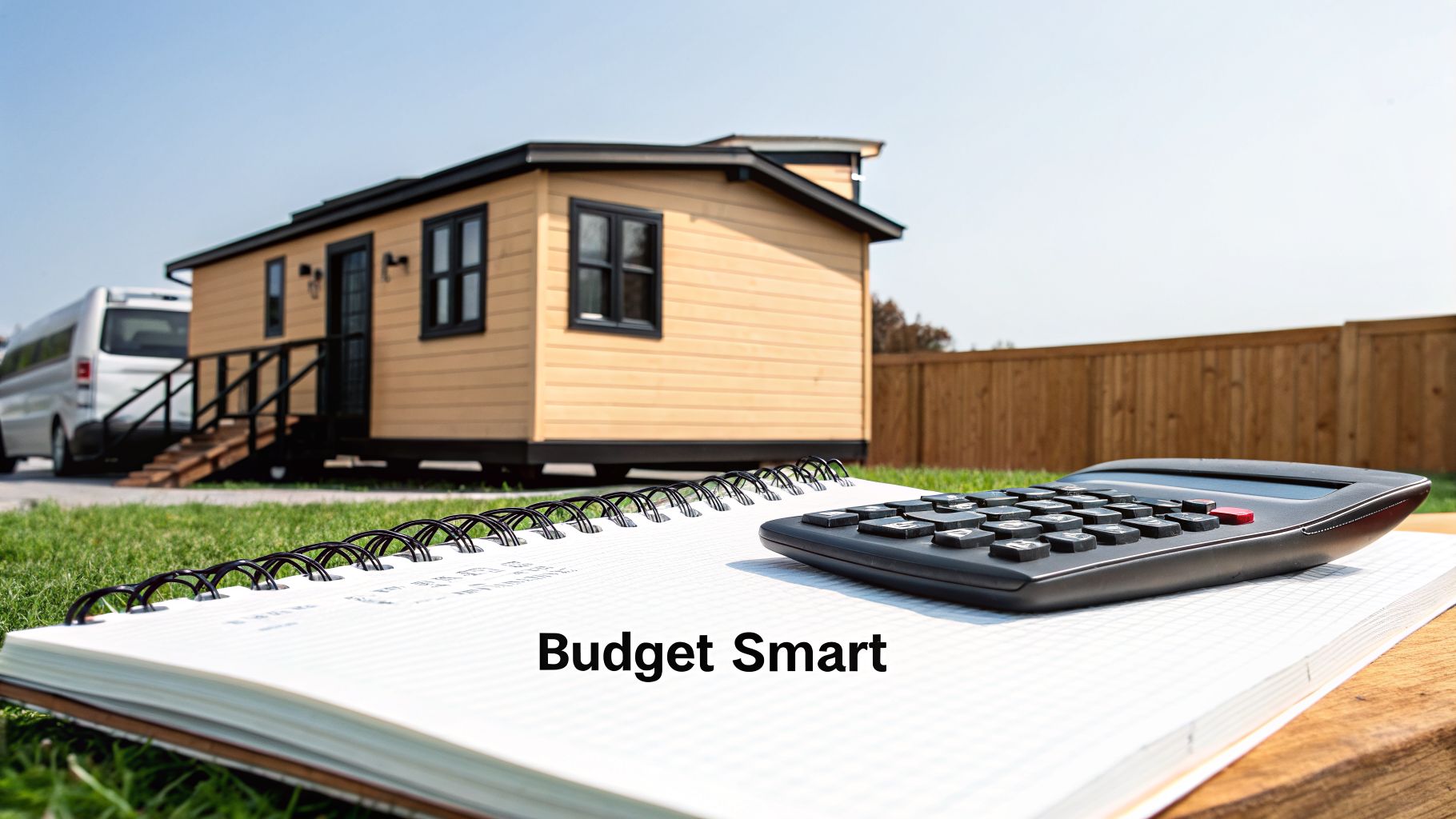
Getting your tiny house loan approved feels like crossing the finish line, but it’s really the starting line for smart financial stewardship. This next phase—managing your loan and your new budget—is where the promise of financial freedom truly takes shape.
Think of your new budget as more than just a list of expenses. It’s the game plan that ensures your tiny living dream remains stress-free and financially rewarding.
Crafting Your Tiny Life Budget
A realistic budget is your best defense against surprises. You need to account for every recurring cost associated with your THOW, not just the big-ticket loan payment. Forgetting a few key categories is a rookie mistake that can quickly throw your finances off track.
Here’s a practical breakdown of what your monthly plan must include:
- Loan Payment: Your fixed monthly obligation to the lender.
- THOW Insurance: The premium for your specialized tiny house policy.
- Parking Costs: Whether it’s lot rent or a land payment, this is a significant expense. Expect anywhere from $400 to $800+ a month in most places.
- Utilities: Your estimated bills for electricity, water, propane, and internet service.
- Maintenance Fund: This is non-negotiable. Plan to set aside 1-2% of your tiny home’s total value each year for inevitable repairs and upkeep.
Getting these numbers down on paper gives you a crystal-clear picture of your monthly cash flow. From there, you can start optimizing.
Strategies for Smart Loan Management
Simply making your loan payment on time is the bare minimum. The real goal is to get out of debt quickly and build equity. The easiest first step? Set up automatic payments. It’s a simple move that protects your credit score from the damage of an accidental late payment.
Smart loan management isn’t just about paying bills; it’s about paying down your principal faster to free up cash for travel, savings, or other life goals.
Once autopay is handled, you can get more strategic with these proven tactics:
- Make Bi-Weekly Payments: Split your monthly payment in half and pay that amount every two weeks. Because there are 26 two-week periods in a year, you’ll end up making one full extra payment annually. This simple change can shave years off your loan.
- Round Up Your Payments: If your payment is, say, $465, round it up to $500. That extra $35 goes directly toward your principal balance, accelerating your payoff with almost no noticeable impact on your monthly budget.
This disciplined approach is what makes tiny living so powerful. When you’re financing a tiny house on wheels, your monthly payments are often just $300-$600. Compare that to a conventional mortgage, which easily tops $2,000 a month. This creates a massive budget surplus you can redirect. As you can see from these insightful cost comparisons, that’s how you supercharge your journey to financial independence.
Common Questions About Tiny House Financing
Once you start digging into the details of financing, you’ll find it’s a world of its own—especially when your home has wheels. It’s not at all like getting a traditional mortgage, and a few key questions come up time and time again.
Let’s clear up some of the most common points of confusion so you can move forward with your plan, fully prepared for what’s ahead.
Can I Get a Loan for a DIY Tiny House Build?
This is one of the toughest hurdles in tiny living. While it’s not impossible to get a loan for a self-build, financing a DIY project is a whole different ballgame compared to buying a professionally built tiny home.
Most lenders get nervous about DIY builds. From their perspective, there’s a higher risk that the project might stall out, go over budget, or not meet safety standards. Because of this, standard RV and chattel loans are almost always off the table for DIYers.
So, what works? An unsecured personal loan is your most realistic option. The lender’s decision here hinges entirely on your financial profile—your credit score, income, and existing debt—not the house itself. This gives you the freedom to build what you want, how you want.
A few credit unions might offer a construction-style loan with phased payouts (draws), but these are pretty hard to find. To get any lender on board, you need to show them you’re a safe bet. Be ready to present:
- A highly detailed build plan, complete with professional-looking blueprints.
- A comprehensive, line-item budget that accounts for every nail and screw.
- A strong personal financial history, including a solid credit score and verifiable income.
If you already own a home, a Home Equity Line of Credit (HELOC) is often the simplest path forward. It gives you the most flexibility for a DIY build and usually comes with much better interest rates.
What Credit Score Do I Need for a Tiny House Loan?
There’s no single “magic number,” as the credit score you’ll need really depends on the type of loan you’re after. Think of it this way: a higher score always opens more doors and gets you better deals.
If you’re looking at an RV loan for a certified tiny house, most lenders are looking for good to excellent credit. You should be aiming for a score of 680 or higher. Some lenders might dip down to the 640 range, but be prepared for that to come with significantly higher interest rates.
For unsecured personal loans, the credit requirements can be a bit more forgiving. You’ll find online lenders who work with scores in the low 600s. Just know that this accessibility comes at a price—interest rates can easily climb above 20%.
Pro Tip: To give yourself the best possible negotiating power and access to the lowest interest rates, your goal should be a credit score of 720 or above. This makes you a prime candidate for nearly any lender.
A HELOC also requires good credit, typically 680+, along with having enough equity in your existing home to borrow against.
Does My Tiny House Need to Be Certified to Get Financing?
For certain loans, yes—and it’s a huge advantage either way. If you’re aiming for an RV loan, certification is almost always a non-negotiable requirement.
Lenders offering RV loans need to see that your tiny house is certified by the Recreational Vehicle Industry Association (RVIA) or a similar body like the National Organization of Alternative Housing (NOAH). This certification is their proof that the home was built to strict safety and quality standards, making it a reliable asset for them to finance. Without it, you’re unlikely to get approved.
On the other hand, if you’re using a personal loan or a HELOC, certification isn’t a deal-breaker for the lender. That’s because the loan is secured by your personal creditworthiness or your home’s equity, not the tiny house itself.
Even if your loan doesn’t require it, I strongly recommend pursuing a certified build. It makes getting insurance and finding legal, long-term parking infinitely easier down the road. These are critical pieces of the puzzle that lenders will indirectly consider when assessing your overall plan.
Are There Government Loans for Tiny Houses on Wheels?
In nearly all cases, the answer is no. Major government-backed mortgage programs like FHA, VA, and USDA loans are strictly for financing real estate—a home permanently fixed to a foundation on land you own.
A tiny house on wheels (THOW) is legally considered personal property, just like an RV or a car. It simply doesn’t meet the foundational (pun intended) requirement for a real estate mortgage. While you may hear buzz about pilot programs for tiny homes on permanent foundations, THOWs don’t qualify for this type of government support.
Your best and most realistic options are in the private lending world. You’ll need to focus on securing an RV loan, chattel loan, unsecured personal loan, or HELOC from a credit union, bank, or specialized financing company.
Back to Tiny House Space Saving Tips
Explore more tiny home living, design, downsizing, building, and lifestyle resources.
- Tiny Homes for Rent in Wyoming: Wild West Getaways to Book
- Tiny Homes for Rent in Washington: Forest Escapes & Cozy Stays
- Tiny Homes for Rent in Utah: Red Rock Retreats to Book
- Tiny Homes for Rent in Oregon: Forest Retreats You’ll Love
- Tiny Homes for Rent in New Mexico: Desert Gems & Starry Skies
- Tiny Homes for Rent in Nevada: Desert Hideaways Worth Booking