The Real Cost of Building a Tiny House in 2026

So, you're wondering what it actually costs to build a tiny house. Let's get right to it. In 2026, you can generally expect to spend somewhere between $35,000 and $95,000. But that’s just a ballpark figure—the final number on your invoice will swing wildly depending on whether you’re a dedicated DIYer, buying a ready-made shell, or hiring a pro for a full custom build.
Understanding Your Initial Tiny House Investment
Before you start picking out finishes or designing your dream loft, you need a solid grasp of the financial landscape. A tiny house budget isn't one fixed price; it's a range of possibilities shaped by your choices in labor, materials, and overall complexity.
To put some real numbers on it, recent industry findings show that a standard 300-square-foot prefab model often lands between $45,000 and $75,000. If you go the custom-built route, that same-sized home can quickly climb into the $75,000 to $135,000 range. It’s a perfect example of how much your personal touch can influence the final price tag.
To give you a clearer starting point, here’s a quick snapshot of the current cost landscape.
2026 Tiny House Cost Averages at a Glance
| Build Type | Average Total Cost | Average Cost per Square Foot |
|---|---|---|
| DIY Build | $25,000 – $50,000 | $100 – $175 |
| Prefab/Shell | $45,000 – $75,000 | $150 – $250 |
| Custom Pro Build | $75,000 – $135,000+ | $250 – $450+ |
As you can see, the path you choose—from rolling up your own sleeves to hiring a team of experts—is the single biggest factor in your total investment.
Why Tiny Houses Can Cost More Per Square Foot
Here’s something that trips a lot of people up: the cost per square foot. It seems backwards, but tiny homes often have a higher price per square foot than traditional houses—sometimes by as much as 38%.
Think about it this way. Every single home needs a kitchen and a bathroom. These are, without a doubt, the most expensive and intricate parts of any build, packed with appliances, plumbing, wiring, and fixtures. In a 2,000-square-foot suburban house, you spread the high cost of those two rooms over a massive area. In a tiny home, you’re cramming all that same essential, expensive infrastructure into just a few hundred square feet. This concentration of cost naturally inflates the per-square-foot metric.
Key Takeaway: While the total cost to build a tiny house is a fraction of a traditional home, the per-square-foot number looks high because you're packing all the expensive systems (kitchen, bath) into a much smaller footprint. You’re paying for the same core functionality, just in a hyper-efficient package.
Foundation vs. Wheels: The First Big Cost Decision
Right out of the gate, your first major decision will split your budget into two distinct paths. Deciding between a permanent foundation or a mobile Tiny House on Wheels (THOW) sets the financial tone for your entire project.
Tiny House on Wheels (THOW): Going mobile means buying a specialized, road-legal trailer. This is a big-ticket item, typically running between $7,000 and $15,000. While it’s a hefty upfront cost, it gives you the freedom to move and can often help you navigate tricky local zoning and permit rules.
Foundation Home: Opting for a permanent structure involves site prep, excavation, concrete, and hooking up to utilities. This route can cost anywhere from $7,000 to over $20,000, depending on your foundation type (like a slab or crawl space) and the going rate for labor in your area.
This choice is the first fork in the road for your budget. A THOW front-loads a significant cost into the trailer purchase, whereas a foundation home’s costs are tied to your specific piece of land. Getting this first step right is crucial for building a budget that’s both accurate and realistic.
Choosing Your Path: DIY vs. Professional Builder
The single biggest factor that will shape your tiny house budget isn't the granite countertops or the composting toilet—it's who will actually hold the hammer. Deciding whether to build it yourself (DIY) or hire a professional builder is the first major fork in the road, and it sets the tone for your entire project. This choice is about more than just money; it's a fundamental trade-off between your budget, your timeline, and your own skills.
Going the DIY route is all about sweat equity. You are literally trading your own time and labor for what can be massive financial savings. Make no mistake, though, this is a serious commitment. Most first-time builders can expect to spend anywhere from 120 to 500 hours on construction. That huge range is why prefab shells or kits are so popular—they can help you land on the lower end of that time investment.
The DIY Builder Route
When you decide to build your own tiny house, you are the boss. You’re in complete control of the timeline, you get to hand-pick every single material, and you can spend your weekends hunting for deals on everything from reclaimed barn wood to floor-model appliances. This path offers the absolute lowest final cost because you're cutting out the number one expense in any build: a contractor's labor, overhead, and profit margin.
But with that freedom comes a ton of responsibility. You need to have a very honest conversation with yourself about your abilities. Do you actually have the framing, basic plumbing, and electrical skills needed? If not, are you genuinely excited to learn them, even when you're tired and frustrated?
- Tool Costs: Unless you have a fully-stocked workshop, you'll be buying, renting, or borrowing a lot of tools. This can easily add a few thousand dollars to your budget.
- Mistake Costs: We all make them. But in construction, a single mis-cut piece of framing or a window that isn't sealed properly can mean wasting expensive materials and creating costly problems down the line.
- Time Investment: Don't forget that your "free" labor isn't truly free. Every hour you spend building is an hour you can't be working, spending time with family, or just relaxing. There’s a real opportunity cost.
The DIY path is a fantastic fit for people who have more time than money, a solid foundation of hands-on skills (or a real passion for learning them), and the primary goal of getting into a tiny house for the lowest possible price.
Hiring a Professional Builder
Handing your project over to a professional builder offers a completely different kind of value: peace of mind. A reputable builder brings years of experience, a network of suppliers, and a deep knowledge of building codes and best practices. It’s the fastest and most reliable way to get a high-quality, safe, and certified tiny home, often backed by a warranty.
Of course, that expertise and convenience come at a price. A builder's fee doesn't just cover their time; it pays for their workshop, business insurance, employee wages, and the profit that keeps them in business. This is why a professionally built home can often cost double what a DIY build with the exact same materials would.
Builder vs. DIY: A Clear Choice: Hiring a builder is like buying a finished product—it comes with a predictable timeline and a guarantee of quality. Going DIY is like investing your own time and energy to create something totally custom from scratch, for a fraction of the sticker price.
Ultimately, this decision comes down to a moment of brutal honesty. Take a hard look at your available time, your hands-on abilities, and your tolerance for stress. If you’ve got the time and grit, a DIY build can be an incredibly empowering and rewarding experience. But if you value speed, expert craftsmanship, and a stress-free process, paying a professional is a smart investment in getting your tiny house dream built right.
Decoding Your Tiny House Budget: Materials and Systems
So, you have a number in your head for your tiny house budget. Now comes the real work: turning that single figure into a detailed, actionable plan. Think of your total tiny house cost as a completed puzzle; to get there, you first need to understand the price of every single piece, from the trailer it sits on to the faucet in the kitchen sink.
Let's start by building the skeleton of your home. This structure is your first major line item and dictates the scope and cost of everything that follows.
Structural and Exterior Essentials
Your tiny home has to stand up to a lot, whether it’s weathering a storm in one spot or handling the vibrations of a cross-country road trip. The materials you pick for the outer shell aren’t just about looks—they're a direct investment in your home’s long-term health and durability.
These initial costs create the backbone of your entire project. Here's a realistic look at what you can expect to spend on these core structural components:
- Foundation or Trailer: As we've covered, this is your starting point and a place you absolutely cannot afford to cut corners. A new, purpose-built trailer for a THOW will typically run between $7,000 and $15,000. A permanent foundation is a similar investment, ranging from $7,000 to over $20,000, depending on the type and complexity.
- Framing: This is what gives your home its shape. Wood framing is by far the most common and budget-friendly option, with lumber costs usually landing between $3,000 and $6,000. If you opt for steel framing—which is lighter and stronger—be prepared for the cost to jump by 20-30%.
- Sheathing and Insulation: These materials wrap the frame, providing structural support and, crucially, energy efficiency. A combination of plywood or OSB sheathing and good-quality insulation (like spray foam) can cost anywhere from $2,000 to $5,000.
- Exterior Finishes: This is the skin of your home—the siding and roofing. Durable and popular choices like metal roofing often cost $1,500 to $4,000. Siding has a huge price range, from affordable vinyl to premium cedar, with costs falling between $2,000 and $7,000.
For a much deeper dive into the pros and cons of these options, check out our guide that answers the question: what are tiny homes made of?
The path you choose—building it yourself or hiring a pro—will have a massive impact on your budget from this point forward.
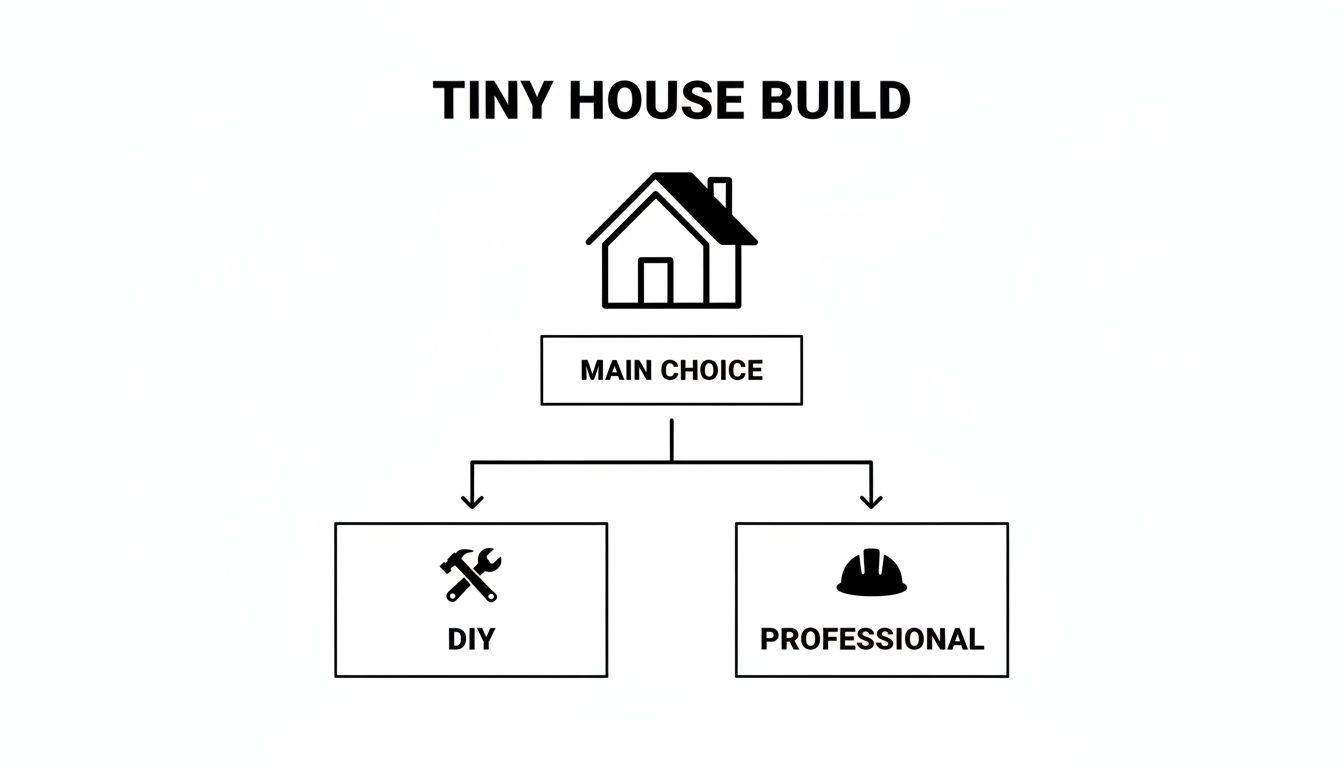
As you can see, the core material costs are a constant. The big variable is whether you're paying for your own time and effort or a builder's expertise.
The Big Three Systems: Electrical, Plumbing, and HVAC
Next up are the brains and arteries of your home: the electrical, plumbing, and HVAC (heating, ventilation, and air conditioning) systems. These are the complex networks that make a tiny structure a comfortable and functional place to live, and this is where costs can escalate quickly.
For many tiny house builds, the "big three" systems can consume a staggering 30-40% of the entire budget. Why? The compact nature of a tiny home requires custom, intricate work, which is why hiring skilled tradespeople for these jobs is often a significant expense.
The need for licensed electricians and plumbers is a major budget driver, especially in markets like the US. When you add the cost of a trailer ($7,000-$15,000) and utility hookups ($5,000-$15,000), you can see how the total investment for a fully functional home can easily reach between $50,000 and $100,000, even before you get to the pretty stuff.
Sample Tiny House Budget Breakdown
To help you visualize how these costs stack up, we've put together a sample budget for a professionally built, $70,000 tiny home. This table shows how the money is typically allocated across the major expense categories.
| Expense Category | Estimated Cost | Percentage of Total Budget |
|---|---|---|
| Trailer | $10,500 | 15% |
| Framing & Sheathing | $6,300 | 9% |
| Insulation | $3,500 | 5% |
| Roofing & Siding | $7,000 | 10% |
| Windows & Doors | $4,900 | 7% |
| Electrical, Plumbing & HVAC | $14,000 | 20% |
| Interior Finishes | $8,400 | 12% |
| Appliances & Fixtures | $4,900 | 7% |
| Labor & Builder's Fee | $10,500 | 15% |
Remember, this is just a sample. A DIY build would shift the "Labor" percentage into other categories, while high-end finishes could easily double the "Interior Finishes" or "Appliances" budget.
Interior Finishes and Fixtures
Finally, we get to the fun part: the interior elements that turn your well-built shell into a home that feels like you. This category is where your personal style and budget have the biggest impact. You can go incredibly frugal or completely luxe.
Here are the key interior expenses to plan for:
- Flooring: Your options are wide open, from budget-friendly laminate or vinyl ($500-$1,500) to beautiful hardwood or durable luxury vinyl tile ($2,000-$4,000).
- Walls and Ceilings: While drywall is the cheapest route, many tiny dwellers prefer the aesthetic of lightweight wood paneling like pine or cedar, which can cost $1,000 to $3,500.
- Cabinetry and Countertops: This is a major line item. Tiny homes depend on clever, often custom, storage solutions. Expect to budget $3,000 to $8,000 or more for quality cabinets and countertops.
- Fixtures and Appliances: This covers everything from your kitchen sink and shower to your toilet, refrigerator, and cooktop. You can find basic, functional models for around $2,500, or you can invest in high-end, compact appliances that can exceed $10,000.
Uncovering The Hidden Costs Of Going Tiny
So you've got a price from your builder or a materials list for your DIY build. That’s a great start, but it's only part of the story. The number on that spreadsheet doesn’t account for a whole host of "soft costs"—those sneaky expenses that are all too easy to forget but can blow up even the most disciplined budget.
Think of it like planning a big road trip. You budget for gas and hotels, of course. But what about the toll roads, the flat tire you didn't see coming, or the ridiculously expensive snacks at that one remote gas station? Ignoring these possibilities is a sure way to run out of cash before you reach your destination.
Key Insight: A truly solid tiny house budget anticipates the entire ecosystem of costs needed to make it a legal, functional home. From my experience, these hidden expenses frequently add an extra 10-20% to the total project cost.
Land And Site Preparation
Before you can hammer a single nail, you need a place to put your home. This is often the first, and biggest, surprise cost you’ll encounter, especially if you're building on a permanent foundation.
- Land Purchase or Lease: Buying land is a major investment, running from a few thousand dollars in a rural spot to tens of thousands in a more populated area. Leasing is cheaper upfront but means you have a recurring monthly payment.
- Land Surveys: You may need a professional survey to officially mark your property lines. Budget around $500 to $2,000 for this.
- Site Prep: This is the literal groundwork. It involves clearing trees, leveling the ground, and grading an access road. Depending on how rugged your land is, this work can easily cost $1,500 to $5,000 or more.
Permits And Professional Fees
Next up is navigating the wonderful world of bureaucracy. Getting the official green light to build isn't free, and the paperwork and professionals involved come with their own price tags.
Don't be tempted to skip this step. It’s what makes your home safe and compliant with local laws. The alternative could be hefty fines or, in a worst-case scenario, an order to tear your structure down.
- Building Permits: Fees vary wildly between municipalities, but a realistic range is $400 to over $2,500.
- Zoning Applications: If your land isn't already zoned for a tiny house, you might need to apply for a variance, a process that includes its own fees and hearings.
- Architect or Engineer Fees: Some jurisdictions insist on stamped plans from a licensed professional. This can add $1,000 to $4,000 to your budget.
Utilities And Transportation Costs
A house isn’t a home without power and running water. For foundation-built tiny homes, connecting to public utilities is a significant expense. You'll have to pay for trenching and hookup fees for water, sewer, and the electrical grid, which can collectively run from $5,000 to over $15,000. If you want a deeper look, our guide on the cost to install plumbing in a tiny house breaks it all down.
For Tiny Houses on Wheels (THOWs), the big hidden cost is transportation. Unless you happen to own a heavy-duty truck that can safely tow 10,000+ pounds, you’ll be hiring a professional moving company. Getting your finished home from the build site to its final parking spot can cost anywhere from $2 to $5 per mile.
This growing interest in movable, affordable homes is no small trend. Projections show the global tiny homes market is on track to hit $14 billion in 2026, growing at a 6.4% annual rate, with most of that growth happening right here in North America and Europe. You can discover more insights about the growing tiny home market on JackCooper.com.
Taxes And Other Miscellaneous Fees
Finally, don't forget about good old Uncle Sam. Depending on your state and how you buy your materials or finished home, you could be on the hook for sales tax or use tax. For a $70,000 build, a 7% sales tax adds another $4,900 to your bottom line. These last-minute costs are easy to overlook but absolutely critical for an accurate budget.
How To Finance And Insure Your Tiny Home
When it comes to paying for and protecting your tiny house, you’ll quickly find the usual rules of real estate don't apply. Traditional mortgages are almost always off the table. Most banks see a tiny home as either too small to properly appraise or, if it has wheels, too mobile to serve as reliable collateral.
But don't let that discourage you. It just means you need to get a little creative and look at financial products built for assets that fall outside the norm.
Finding The Right Financing For Your Build
So, where do you turn for the cash? Most people end up exploring one of a few common routes, each with its own benefits and drawbacks. It really pays to understand the fine print on these.
Here are the most common ways to fund a tiny house project:
- Personal Loans: This is easily the most popular choice. You can get an unsecured personal loan from a credit union, bank, or online lender for just about any purpose, and building a tiny home certainly qualifies. The trade-off is higher interest rates, often between 6% to 20% or more, but the approval process is usually much quicker.
- RV Loans: If you're building a Tiny House on Wheels (THOW) and get it certified by the RV Industry Association (RVIA), an RV loan becomes a real possibility. These loans tend to offer better terms (10-15 years) and lower rates than personal loans. The catch? Your build has to follow very strict safety and construction standards to get that certification.
- Builder Financing: Many professional tiny home builders have established relationships with lenders who get this niche. This can be incredibly convenient, but always compare the rates they offer with outside options. Sometimes you pay a premium for that one-stop-shop experience.
Important Consideration: No matter which path you take, your credit score is king. A strong score is your ticket to lower interest rates and better terms, which can save you thousands of dollars over the life of your loan.
Insuring Your Tiny House Investment
Once the build is funded, you have to protect your investment. Just like with financing, tiny house insurance isn't exactly straightforward. The right policy for you hinges entirely on one question: is your home mobile or is it fixed to a permanent foundation?
The goal is to find an insurer who actually understands the tiny living movement and won't try to shoehorn you into a policy that doesn't fit. For a deep dive into the different loan types out there, you can learn more about tiny home financing options in our detailed guide.
Types Of Tiny Home Insurance Coverage
As you start shopping for quotes, you’ll see that insurers draw a hard line between mobile and stationary structures. They are treated as completely different risks.
Here’s what you’ll be looking for based on your setup:
- For a THOW (RV Insurance): If your home is an RVIA-certified THOW, you'll need a specialized RV policy. If it’s your main home, make sure the policy includes "full-timer liability" coverage. You'll also want robust personal property protection and trip collision coverage for when you're actually towing it down the highway.
- For a Foundation Home (Homeowners Insurance): This is much simpler. A tiny house on a permanent foundation should qualify for a standard homeowners insurance policy (often an HO-3). This covers the structure itself, your belongings, and liability—just like any traditional house.
Your best bet is to find an insurance agent who has written policies for tiny homes before. They’ll know exactly how to navigate the system and secure a policy that truly protects your unique and valuable home.
Getting Creative: How to Trim Your Tiny House Budget
Choosing to build a tiny house is already a huge leap toward a more financially flexible life. But you can stretch your dollars even further by making smart choices during the actual build. This is about building smarter, not just cheaper—blending clever material sourcing with practical design and a good sense of long-term value.
Believe it or not, where you build can have a massive impact on your final price tag. Labor rates, the cost and availability of materials, and how friendly the local building codes are to tiny homes can swing your budget wildly. For example, states like Arkansas see an average tiny home price of around $31,700, while in California, that same home could easily cost $75,600. Simply choosing a tiny-home-friendly state from the start can save you a fortune on land and permits alone.
Consider a Hybrid Build
One of the best ways to get the best of both worlds—cost savings and professional quality—is to go with a builder’s shell. Think of it as the perfect middle ground between a full-on DIY project and handing the whole thing over to a pro.
A builder will construct the bones of the house: the trailer, framing, sheathing, roofing, and even install the windows. They hand you a weather-tight, structurally sound shell, and you take it from there. This approach lets you save thousands on labor by tackling the interior finishes yourself, all while knowing the critical structure is built to last. It’s a fantastic way to eliminate the risk of big, costly mistakes.
Become a Master of Sourcing
This is where your budget creativity can really shine. Embracing reclaimed, salvaged, and secondhand materials is a time-honored tiny house tradition, and for good reason.
- Reclaimed Goodness: Architectural salvage yards are absolute treasure troves. You can find unique doors, vintage windows, hardwood flooring, and old-growth lumber for a fraction of what they’d cost new.
- Floor Models and "As-Is" Finds: Never underestimate the power of the "as-is" or scratch-and-dent section at big-box hardware stores. You can snag amazing deals on appliances, cabinets, and light fixtures that have minor cosmetic blemishes.
- Local Marketplaces: Keep a close eye on sites like Facebook Marketplace and Craigslist. People are constantly offloading surplus materials from their own renovations, from extra boxes of tile to leftover insulation.
Design for Simplicity
Complex designs look interesting, but they come at a steep price. A simple, rectangular footprint is always going to be cheaper and faster to build than a design with lots of nooks, crannies, and dormers. Every extra corner adds time and money to the framing, siding, and roofing stages.
In the US, a professionally built tiny house typically lands somewhere between $40,000 and $100,000. Custom cabinetry is a notorious budget-eater, often consuming 15% of the total cost. While you can find savings on finishes, one area you don't want to cut corners on is the roof; that's why nearly 70% of builds use durable metal roofing. You can learn more about how professionals price their tiny home builds on JackCooper.com.
Finally, always think about the long game. Investing in energy efficiency upfront is one of the smartest financial moves you can make. Spending a bit more on better insulation or a small solar panel system might raise your initial cost, but it will dramatically lower your utility bills for years, ultimately reducing your total cost of ownership.
Frequently Asked Questions About Tiny House Costs
Every tiny house journey starts with a budget, and that's where some of the biggest questions come up. Let's clear the air on a few of the most common ones to help you plan with confidence.
Can You Really Build a Tiny House For Under $20,000?
Yes, you can. But it's crucial to understand what that actually involves. Hitting that $20,000 price point almost always means you're a skilled DIYer with a ton of free time, and you've become an expert at finding free or dirt-cheap reclaimed materials.
This isn't the path for most people. You're essentially trading money for hundreds of hours of your own labor—what we call "sweat equity." While the super-low-budget builds you see online are inspiring, they often compromise on things like long-term durability and professional-grade safety. They represent the extreme end of the DIY spectrum, not the average experience.
Why Is The Cost Per Square Foot Higher Than a Regular House?
This one trips a lot of people up, but it makes perfect sense when you think about it. Your biggest costs—the kitchen and the bathroom—are packed with expensive plumbing, electrical work, and appliances.
In a 2,500-square-foot traditional home, the cost of that kitchen and bathroom gets spread out over a huge area, bringing the average price per square foot way down.
In a tiny house, you're squeezing all of that expensive infrastructure into a tiny 250-square-foot space. You don't have hundreds of square feet of "cheap" space (like empty hallways or simple bedrooms) to dilute the cost. You’re paying for the same complex systems, just in a hyper-efficient package.
What Is The Biggest Unexpected Cost To Plan For?
Surprises are part of any building project, but the biggest budget-killers usually depend on whether your home is on a foundation or on wheels. Knowing which ones to watch for can save you a world of financial pain.
For a tiny house on a permanent foundation, the costs that sneak up on people are almost always land-related:
- Land Preparation: Just clearing, grading, and creating a driveway can run into thousands of dollars before you even break ground.
- Utility Hookups: This is the big one. The cost to trench and connect to public water, sewer, and the electrical grid is often a shock—it can easily top $15,000 in some areas.
For a Tiny House on Wheels (THOW), the hidden costs pop up when you try to move it or park it:
- Transportation: Hiring a professional to move your home isn't cheap. It can run $2 to $5 per mile, which adds up fast on a long-distance haul.
- Code Compliance: You might arrive at your destination only to find you need expensive, last-minute changes to meet the specific rules of an RV park or a local ordinance.
Explore more tiny home living, design, downsizing, building, and lifestyle resources.
- Tiny Homes for Rent in Wyoming: Wild West Getaways to Book
- Tiny Homes for Rent in Washington: Forest Escapes & Cozy Stays
- Tiny Homes for Rent in Utah: Red Rock Retreats to Book
- Tiny Homes for Rent in Oregon: Forest Retreats You’ll Love
- Tiny Homes for Rent in New Mexico: Desert Gems & Starry Skies
- Tiny Homes for Rent in Nevada: Desert Hideaways Worth Booking